
Why Most Homesteads Fail in Year 2 or 3 — And the System That Prevents It
Article 4 of 8 — The WholeStead™ Framework Series from UpRooted Greens
By Tihamtu Chaos-Dragon | UpRooted Greens
I have been building toward my homestead for ten years.
Ten years. On less than one thousand dollars a month — and that budget includes building a business, developing a curriculum of over 320 courses, purchasing tools and equipment, running livestock and garden experiments, and maintaining a life in a subdivision in town while planning a net zero+ homestead I can taste so clearly I can describe it down to the geothermal tubing under the raised floor, the Russian pechka in the kitchen, and the Norwegian-style greenhouse structure wrapped around the entire house for passive heating. I know what the Emus look like in my head. I know where everything goes.
I have not made a dime from the business yet. I am still going.
I am not telling you this to perform resilience. I am telling you because this article is about failure, and I want to be completely honest about what failure actually is — and what it is not.
Failure is not losing quail to a predator. It is not spending 18 months naturalizing a garden before it produces. It is not a chicken living in a dog kennel for a week while you build the coop you should have built first. It is not ten years of building something you believe in while the world moves on around you and the income has not arrived yet.
Failure is one thing and one thing only: stopping.
If you never stop, you cannot fail. You can be delayed. You can be humbled. You can be forced to learn things you did not want to learn in ways you did not want to learn them. But you cannot fail while you are still moving. The only permanent failure available to you is the one you choose.
So this article is not a warning. It is a map of the terrain where people stop — the specific pressure points where homestead dreams tend to collapse — so that you can see them coming, name them for what they are, and keep moving anyway.
Why Year 2 and 3 Specifically? What Changes.
Year one of a homestead is fueled by activation energy. The dream is new enough to be electric. Every small win — the first egg, the first harvest, the first system that works the way you designed it — feels enormous because it is the first evidence that the dream is real. The gap between where you are and where you want to be is wide, but it does not yet feel heavy because you are too busy moving to feel the weight of it.
Year two is where the real work begins, and where the dream starts to reveal its full cost. The novelty has worn off. The systems that worked in year one need maintenance, repair, or replacement in year two. The things you did not build correctly in year one are starting to show their failures. The financial pressure that was abstract in year one is now a number on a spreadsheet that does not close the way you planned it would.
Year three is the proving ground. By now, the people who were doing this for the aesthetic of it have mostly left. The people who underestimated the physical and financial demands have mostly left. What remains are the people who came in with realistic expectations, a real plan, and the kind of commitment that does not require daily reinforcement to stay alive.
The good news: failure in years two and three is almost never caused by external forces. It is almost always caused by one of a small number of internal patterns — patterns that are completely predictable, completely preventable, and completely addressable if you can name them before they cost you everything.
The Six Patterns That Stop Homesteads in Their Tracks
Pattern 1: Building Without a Complete System
The most common pattern by a significant margin: the homestead that was assembled from pieces of different visions rather than built as one integrated plan. A solar system sized for a house that was never designed for passive solar. A water system that works for drinking but was never connected to irrigation. A food system built before the income system was designed, so the food production is eating budget that has no way to replenish itself.
These homesteads do not collapse dramatically. They erode. Each disconnected system creates friction that costs time and money. Over two or three years, the accumulated friction becomes unsustainable — not because any single thing failed, but because the total load of managing five systems that were never designed to work together eventually exceeds what one family can carry.
The WholeStead™ Framework exists specifically to prevent this pattern. Every pillar — Food, Water, Power, Shelter, Income — is designed in relationship to the others from the beginning, so the integration is built in rather than retrofitted at cost.
Pattern 2: The Income System Was the Last Thing Planned
This one is brutal in its predictability. A family saves for years, buys land, builds systems, plants food, acquires livestock — and somewhere in year two realizes that the money they saved is running out and the homestead is not generating the income they assumed it would by now.
The income system was supposed to develop organically. Sell some eggs. Maybe teach a workshop. Eventually it would all come together. Except organic income development on a homestead takes years, not months, and it requires the same intentional planning and infrastructure investment as every other system on the property. It does not develop on its own while you are busy building everything else.
Income planning belongs in Phase 0 of the WholeStead™ Framework. Not because you will be generating income in Phase 0, but because every physical decision you make from that point forward — which crops to grow, where to site the structures, how to design the property flow — should be informed by how the homestead is going to sustain itself financially. A homestead designed with income in mind from the beginning looks different from one where income was added as an afterthought. It produces differently, earns differently, and survives differently.
Pattern 3: Mistaking Motion for Progress
Being busy on a homestead and making progress on a homestead are not the same thing. It is entirely possible to work extremely hard every day for two years and end year two further from your goal than you were at the start — if the work is being done in the wrong sequence, on the wrong priorities, or in service of a vision that has not been fully defined.
The people who fall into this pattern are not lazy. They are often the most energetic, most committed, most hardworking people in the homesteading space. But energy without direction is not progress. It is very tiring motion that looks like progress from the outside and feels like failure from the inside.
The antidote is the kind of plan that tells you not just what to do, but what to do next, and why that order matters. When you have that plan, every day of work is measurably moving you toward a specific phase completion. You can see it. You can track it. You know when you are done with Phase 2 and ready to start Phase 3. That clarity is not a luxury — on a tight timeline and a tighter budget, it is survival.
Pattern 4: Isolation
Homesteading attracts self-reliant people, and self-reliant people can be stubbornly resistant to asking for help. That stubbornness, applied to a project of this scale and complexity, becomes a liability by year two.
The knowledge required to build and maintain a fully integrated self-sufficient homestead spans disciplines that take individual practitioners years or decades to master. No single person comes to this project with all of it. The people who try to figure out everything alone, from first principles, on a live homestead with real stakes attached, pay an enormous price in time, money, and failed experiments that someone else already failed and already documented.
Community is not a soft benefit of the homesteading lifestyle. It is infrastructure. The person who knows what predator tore through your hardware cloth at the seam, because the same thing happened to them two seasons ago, is worth more in that moment than any amount of solo research. Find your people. Stay connected to them. Ask questions without embarrassment. The goal is a thriving homestead, not a solo performance of competence.
Pattern 5: Underestimating the Emotional Load
Homesteading content almost never talks about this. The emotional weight of building something this large, this slowly, with this many setbacks, on a timeline that keeps extending, is significant. Losing animals. Watching a season’s worth of work wiped out by weather. Watching a financial plan not come together the way you projected. Explaining to people around you why you are still doing this when it has not paid off yet.
None of this means the vision is wrong. It means the vision is large and real and costs something. Every meaningful thing costs something. The question is whether the cost is worth what you are building toward — and only you can answer that.
What I know from ten years of building toward something I have not yet reached is this: the people who quit were not weaker than the people who stayed. They were simply out of reasons to keep going. The reasons that keep you going have to be deeper than excitement, because excitement is a first-year fuel and this is a multi-year project. Know why you are doing this at the level underneath the lifestyle. Build your homestead on that foundation. It will hold when everything else is under pressure.
Pattern 6: Comparing Your Year 2 to Someone Else’s Year 10
The homesteading content world runs heavily on finished results and highlight reels. The lush, abundant, clearly thriving homestead in the YouTube thumbnail took eight years to look that way and the channel started when it was year three and mostly mud. You are not seeing year three. You are seeing year ten and being asked to measure your year two against it.
This comparison is one of the most consistent sources of discouragement in the homesteading space. It produces the feeling that everyone else is further ahead, doing it better, producing more, earning more, thriving more effortlessly — when the truth is that everyone in year two is in year two, and year two looks like year two for everyone, regardless of how good the plan is.
Measure your progress against your own plan, not against someone else’s highlight reel. The only relevant comparison is: are you further along than you were six months ago? If yes, you are succeeding. Keep going.
What Actually Prevents Failure: The WholeStead™ Persistence Architecture
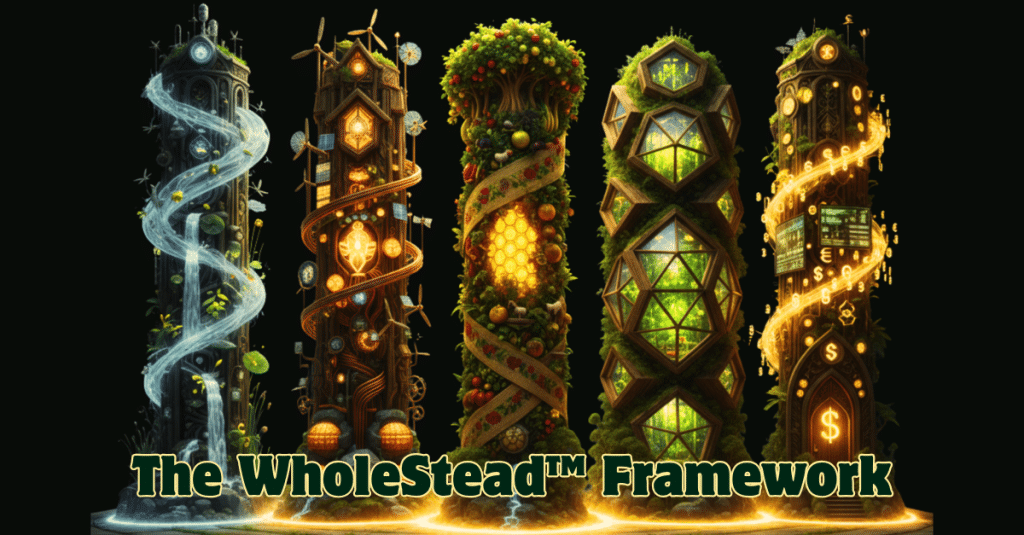
Prevention is not about being stronger, more disciplined, or more naturally suited to this lifestyle than the people who stopped. Prevention is structural. It comes from building your homestead — and your commitment to it — in a way that makes stopping harder than continuing.
What that structure looks like in practice:
- A complete integrated plan before the first dollar is spent on infrastructure. Not a vision board. Not a rough idea. A real plan with phases, sequences, budgets, and income projections that you have thought all the way through. The plan is what you return to when you feel lost. If you do not have one, every hard moment is an invitation to quit. If you have one, every hard moment is just a problem to solve on the way to a destination you can still see clearly.
- Income designed into the build, not added to it later. Financial pressure is the single most common proximate cause of homestead abandonment. A homestead that is generating income — even modest income — is structurally more survivable than one that is purely consuming it. Plan the income before you plan the garden.
- Small wins engineered into every phase. The WholeStead™ Framework is phased deliberately so that each phase has a clear completion point. Completing a phase is a win you can see and measure. Wins sustain commitment in a way that abstract progress toward a distant goal does not.
- Community that knows what you are building. People who understand the project and believe in it are not a nice-to-have. They are the external mirror that reflects your progress back to you on the days when you cannot see it yourself. Build that community intentionally.
- A reason deeper than the lifestyle. I believe that what I am building at UpRooted Greens has the potential to change the fabric of existence for people who have been told that a different kind of life is not available to them. That is not a small reason. That is the kind of reason that survives ten years and a budget under a thousand dollars a month and not a dime of revenue yet. Know your reason at that depth. Write it down. Return to it when the smaller reasons run out.
What I Can Taste From Here
I want to tell you what ten years of not stopping looks like from where I am standing, because I think it matters for anyone who is in year one or year two and wondering if this is going to work.
I can see the homestead so clearly it is almost physical. The house built inside a greenhouse structure the way they build them in Norway — the greenhouse providing a climate buffer that dramatically reduces heating and cooling loads year-round. A Russian pechka in the kitchen, a masonry mass heater that burns hot and clean and stores heat in its thermal mass for hours after the fire goes out. Geothermal tubing running under a raised floor, giving me the option to heat or cool from the ground itself. Emus. A fully integrated water harvest system. A food forest that took years to establish and will produce for decades. Income systems that were designed into the property from the beginning and are now generating the financial foundation that makes all of it stable.
I know about the pechka because I did the research. I know about the Norwegian greenhouse method because I did the research. I know about geothermal tubing, and passive solar design, and raised flooring as a thermal distribution system, because I spent years learning everything I could from everywhere in the world that humans have solved the problem of living well with less. That research is now encoded in over 320 courses inside UpRooted Greens. It exists so that every person who comes into this community gets the benefit of that decade of learning without having to spend a decade learning it themselves.
That is what not stopping produces. Not just a homestead. A body of knowledge that can change the trajectory of other people’s lives. A system that works not just for me but for someone starting in a city with no land and less than a thousand dollars to their name, because I started in a city with no land and less than a thousand dollars a month.
I am so close now I can taste it. And I am still going.
You Have Not Failed. You Have Not Finished.
If you are reading this article, you have not quit. You are still here, still looking for the information and the framework that makes this work. That matters more than where you are in the process right now.
The path from where you are to a fully integrated, self-sufficient WholeStead™ is navigable. People who started with less than you have — less money, less land, less knowledge — are further along it than you might believe, because they built a plan, followed the sequence, stayed in community, and kept going when the reasons to stop accumulated.
The question worth sitting with before you take the next step is the same one it always is: which of your five homestead systems is your most vulnerable right now? Because that is where the pressure will come from in year two or three. That is where the plan needs to be strongest before you get there.
The free 10-Point Homestead Vulnerability Assessment inside UpRooted Greens was built for exactly this moment — the moment when you are still in it, still committed, but want an honest picture of where your gaps are before they become the thing that finally makes stopping feel like the only option. Ten systems. Clear assessment. Real answers. No fluff.
You have not failed. You have not finished. Those are not the same thing. Keep going.
Take the Complementary 10-Point Homestead Vulnerability Assessment
The Wholestead Path to Sovereignty
STEP 1: THE AUDIT (Complimentary) Analyze the cracks in your current foundation with the 12-module situational assessment.
STEP 2: THE ARCHITECTURE (The Curriculum) Master the 5 Pillars: Water, Power, Food, Shelter, and Income. Build a system that outlasts the current one.
STEP 3: THE LEGACY (Multi-Generational Thriving) Implement the blueprints for permanent housing and land-based income to secure your family's future.
uprootedgreens.com
About the Author
Tihamtu Chaos-Dragon is the founder of UpRooted Greens, a total self-sufficiency education platform built around the WholeStead™ Framework. She has been building toward her fully integrated, net zero+ homestead for ten years on less than one thousand dollars a month — developing 320+ courses, running livestock and garden experiments, and planning a home that draws on building traditions from Norway, Russia, and beyond. She has not stopped. She does not intend to.