
The 5 homestead systems every self-sufficient property needs — and what most people are still missing.
I’ve Been Preparing Since I Was 13. COVID Still Caught Me Off Guard.
I am, by nature, a hermit. I don’t talk to people outside my house regularly. I observe. I think. I pattern-match. And for most of my life, what I observed about the world was that 99% of people on this planet don’t have what they actually need — and they’re living entirely at the mercy of a supply chain they’ve never questioned.
I noticed it before COVID. I’ve been noticing it my whole life.
I ran away from home at 13. When you’re taking care of yourself at 13 — actually taking care of yourself, not just doing chores — you develop a relationship with preparedness that most people never have to find. You learn fast what you need for each situation, because the consequence of not knowing is immediate and personal. There’s no safety net. There’s no one coming.
Add to that a childhood in the military, growing up in the shadow of Cold War anxiety, where the possibility of nuclear strike was treated as a scheduling concern rather than a hypothetical. That kind of upbringing doesn’t make you paranoid. It makes you awake. Hyper-aware. Pattern-oriented. You start to see things other people haven’t thought to look for yet.
So when COVID hit and the supply chain cracked open, I was watching with a particular kind of attention.
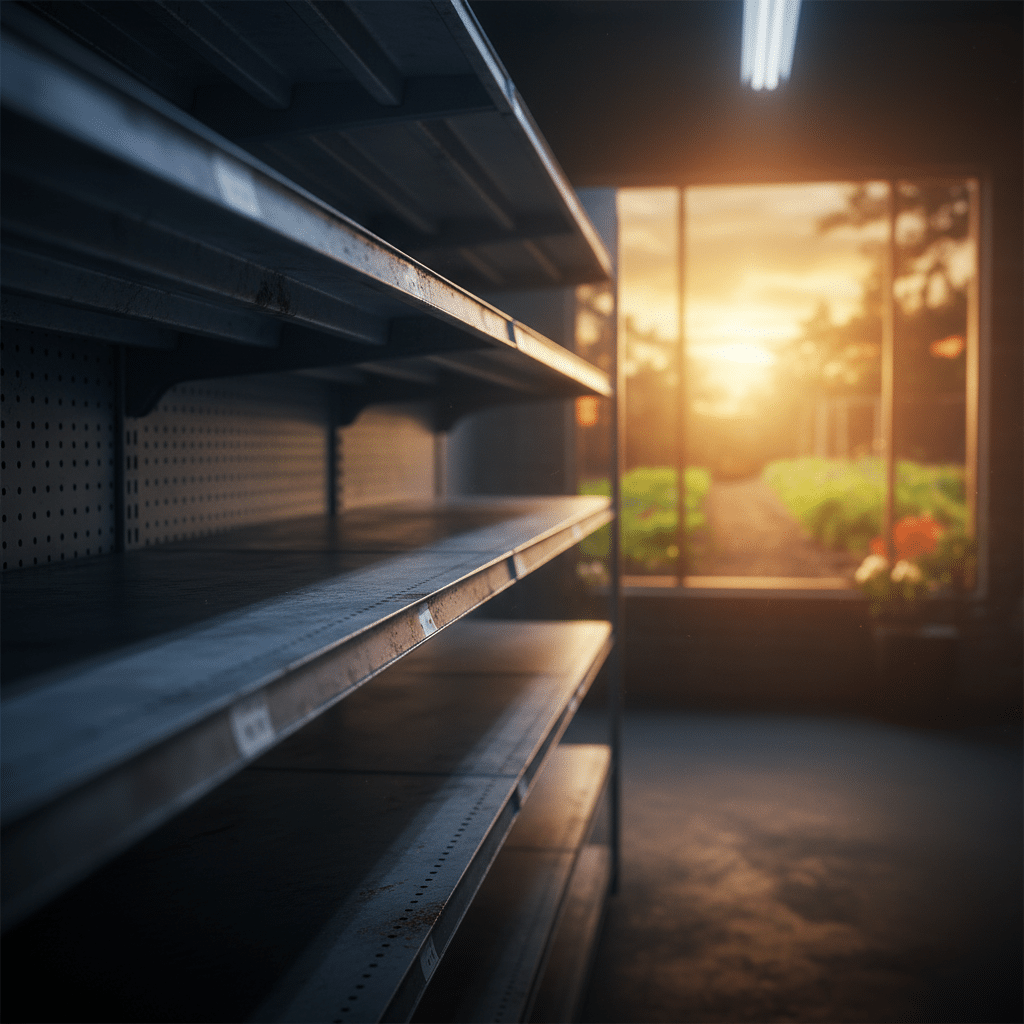
And what I saw was this: the system we had all quietly depended on — even those of us who considered ourselves prepared — was more fragile than anyone wanted to admit. Empty shelves. Shipping delays. Toilet paper as a symbol of collective unraveling. I had prided myself on being ready for anything. And yet there I was, at the mercy of something I had no control over.
I don’t like being at the mercy of anything.
That moment didn’t break me. It clarified something I had been building toward my whole life but hadn’t yet put into a complete framework. The problem wasn’t that people lacked individual skills or individual tools. The problem was that no one had all five systems in place at the same time. Not in an integrated way. Not in a way that actually held when the pressure came.
I also have an unusually high capacity for empathy — something that has survived everything my life has thrown at it, which genuinely surprises me. I feel other people’s pain. And what I felt during COVID, watching millions of people realize the ground was not as solid as they thought, was a kind of collective grief that I could not ignore.
I’m not building UpRooted Greens for fame. I don’t personally need a great deal of money. But I have two kids — not biologically mine, but mine in every way that matters — and I feel a bone-deep need to protect them. To build something that shows the world it is possible to live differently. To prove that you can change the world without destroying it first.
The five systems I’m about to walk you through are not theoretical. They are what I’ve been building, studying, and teaching for the better part of a decade. They are what was missing when the supply chain broke. And they are what every self-sufficient property needs — not someday, but as a plan you start building today.
The 5 Systems Every Self-Sufficient Property Needs
Most people who want to go off-grid think about it in terms of things: solar panels, a garden, a well, maybe a generator. And those things are real and important. But things without a system are just expensive purchases waiting to underperform.
A true self-sufficient property runs on five integrated systems. Each one is a complete domain. Each one depends on the others. And each one needs to be built in the right sequence — which is exactly what The WholeStead™ Framework maps out.
Pillar 1: Water
Water is first because nothing else works without it. Not your garden. Not your animals. Not your household. Not you.
A complete water system is not a hose bib and a municipal connection. It is the full chain: collection or extraction, storage, filtration, and distribution. That means understanding your source — well, rainwater, spring, or surface water — and building redundancy into it so that a single point of failure doesn’t take down your entire operation.
When COVID hit, water wasn’t the immediate crisis — but it would have been next. Municipalities run on chemicals, pumps, and staff. All of those have supply chains. A self-sufficient water system answers to none of them.
Pillar 2: Power
Power comes second because once your water system is designed, you know exactly what it demands. You know what pumps you’re running, what filtration systems need electricity, what your real baseline load is. That knowledge lets you size your power generation correctly instead of guessing.
A complete power system includes generation (solar, wind, hydro, or a combination), storage (battery banks), and distribution (inverters, wiring, load management). The goal is not just to have power — it is to have power that stays on when the grid goes down and costs you nothing month over month.
This is the system that gets the most attention and the most marketing. It is also the one people overbuy or underbuy most often, precisely because they build it before they know what they actually need it to run.
Pillar 3: Food
Food comes third because a reliable water supply and stable power make food production consistent instead of a gamble. You’re not hauling water to your raised beds. You’re not losing your freezer full of preserved food to a power outage.
A complete food system goes beyond a garden. It includes production (growing, raising, foraging), preservation (canning, fermenting, dehydrating, cold storage), and sourcing strategy (what you produce yourself versus what you trade or buy and from whom). It is a system that feeds your household across every season, not just the growing ones.
The empty shelves of 2020 were a food system failure. Not a farming failure — a distribution and dependency failure. The answer is not stockpiling. The answer is producing.
Pillar 4: Shelter
Shelter comes fourth because a property with functioning water, power, and food systems tells you exactly what your structure needs to support. You’re not retrofitting a house that was never designed for self-sufficiency — you’re building or modifying one that already knows its job.
A complete shelter system is more than four walls and a roof. It is insulation, passive heating and cooling, systems integration (where does the water come in, where does the power route, where does food storage live), and resilience features — the things that keep the structure functional when external conditions get extreme.
Most homes are designed for grid dependency. A self-sufficient shelter is designed for the opposite.
Pillar 5: Income
Income comes last because you build it on top of stability — not instead of it. This is the mistake that burns people out: trying to generate land-based income before the land is actually set up to support it.
A complete income system for a self-sufficient property combines what the land produces (cash crops, animal products, value-added goods) with what the owner knows (skills, teaching, consulting, digital products). The goal is not just revenue — it is revenue that reinforces the property rather than depleting it.
This is the pillar that makes everything else sustainable indefinitely. And it is the one almost nobody talks about until they are already exhausted and underfunded.
Why You Need All Five — Not Just the Fun One
Here is what I have observed from a lifetime of pattern-watching: most people build one or two of these systems and call themselves prepared. And they are — partially. Until the one system they didn’t build becomes the one that matters.
The person with a beautiful garden and no water independence is one dry summer away from losing everything they grew. The person with a fully off-grid power system and no food production is still completely dependent on the supply chain for survival. The person with a gorgeous homestead and no income system will eventually be forced to sell it.
The five systems are not a menu to pick from. They are an ecosystem. Each one strengthens the others. Each gap weakens the whole.
This is what COVID revealed — not that people were lazy or uninterested in self-sufficiency, but that the cultural script for “prepared” was incomplete. Stocking up is not a system. A generator is not a power system. A vegetable garden is not a food system. These are starts. The WholeStead™ Framework is the map for building all the way to the finish.
The supply chain breaking wasn’t a warning. It was a preview. The question is what you build between now and the next one.
You don’t have to build all five systems at once. You just have to know where your gaps are before the next disruption finds them for you.
The complimentary 10-Point Homestead Vulnerability Assessment maps all five WholeStead pillars against your current setup and shows you exactly where your plan is exposed. The clarity it gives you lasts a life-time.