
What is an off-grid system — and why do most people build them in the wrong order?
The Day I Came Home With Seven Trees and Zero Plan
Off-grid is sexy, thrilling, adventurous. People who think about going off-grid have a bit of an adventurous spirit — they want to test themselves against nature and see where they land.
And that, in part, is exactly the problem.
When you want to test yourself, you don’t always plan the sequence. When you want adventure, the thought process is go now, now, now. And for those of us who have both ADHD and a desire to do all the things… sometimes that is disastrous.
Hello. I’m Tiha, founder of UpRooted Greens, and I have ADHD. The only way I can concentrate on anything is by dropping into hyperfocus — which is essentially the OCD that a person with ADHD develops out of sheer necessity, just to get anything done at all.
But here’s the thing: you don’t have to have ADHD to fall victim to the “do it now, now, now” impulse. I’ve watched perfectly neurotypical people do it too. And I have a tree story that proves it.
I was at the grocery store one afternoon — just picking up a few things — when I spotted them: pear trees, apple trees, peach trees, lemon and lime trees, all lined up in little plastic bags, all calling my name. So I did what any self-respecting future homesteader does. I bought one or two of each.
I did not think about where I had room to plant seven trees. I did not think about the soil, the compost, or the mulch I’d need to give each one a fighting start. I came home happy, arms full of potential, and then stood in my yard trying to figure out where on earth everything was going to go.
Turns out I didn’t have room for all of them. And a couple of varieties I should have bought two of, I only bought one — and when I went back to the store they were already gone. So I hurriedly planted everything before they died in their bags, without proper soil prep, without mulch, without a plan.
They grew slowly that first year. A little stunted. And then a short cold snap rolled through Texas, and I lost the citrus trees because I had no winter protection plan — because I hadn’t planned anything at all.
Now, I want to be clear: I’m not saying it was wrong. I do have fruit trees in my yard now that will produce for decades. But each tree that died because I didn’t plant it correctly, or didn’t have a plan to protect it through winter, was a lesson that cost me between $20 and $50. Golden lessons — I love those lessons — but expensive ones.
If I had planned it? Holes dug. Soil, compost, and mulch ready for each one. A cold snap plan for the citrus. All trees alive. All money still in my pocket.
That’s not a gardening story. That’s an off-grid systems story. And it plays out at every scale — from a $30 citrus tree to a $30,000 solar installation.
So What Is an Off-Grid System, Exactly?
When most people hear “off-grid,” they picture solar panels. Maybe a well. Maybe a big garden. And yes — those are pieces of an off-grid life. But they’re not the whole picture, and treating them like separate projects is where the real trouble starts.
A true off-grid system is an integrated set of interdependent solutions that allow a household to operate independently of public utilities and commercial supply chains. That means:
- Producing or collecting your own water
- Generating your own power
- Growing or sourcing your own food
- Building or modifying shelter to support those systems
- Creating income or bartering capacity so the whole thing is sustainable long-term
Notice what’s missing from that list? Solar panels. They’re a component of the power system — not the system itself. And the power system is one piece of a much larger picture.
This is why people get into trouble. They fall in love with one exciting piece — the solar setup, the raised beds, the rainwater collection barrels — and they build that piece in isolation, without thinking about how it connects to everything else.
It’s not doing it wrong. It’s just doing it more expensively.
Why the Order You Build in Changes Everything
Here’s something nobody tells you when you’re standing in the store staring at those shiny solar panels: every system you build has dependencies. It needs other systems to function correctly. And if you build the downstream thing before the upstream thing is in place, you will pay to redo it.
A few real examples:
- If you build your garden before you have reliable water, you will either lose crops during a dry stretch or you will be hauling water by hand — which is not self-sufficiency, it is manual labor on a schedule.
- If you install a solar system before you know how much power your shelter actually needs, you will either overbuy (waste money) or underbuy (run out of power when it matters most).
- If you build your income strategy before your food and water are secured, you will burn out trying to run a business while managing a property that still has critical gaps.
These aren’t edge cases. These are patterns I’ve watched repeat across every type of homesteader — the survivalist building for resilience, the family building for legacy, the back-to-the-lander building for freedom. Different motivations, same sequence mistakes.
The sequence isn’t about being rigid. It’s about not paying twice for the same ground.
The Framework That Changed How I Teach This
After more than a decade of homesteading — hands in the dirt since I was five years old, raising quail, chickens, and prawn, welding, building, problem-solving on a shoestring — I developed what I now call The WholeStead™ Framework.
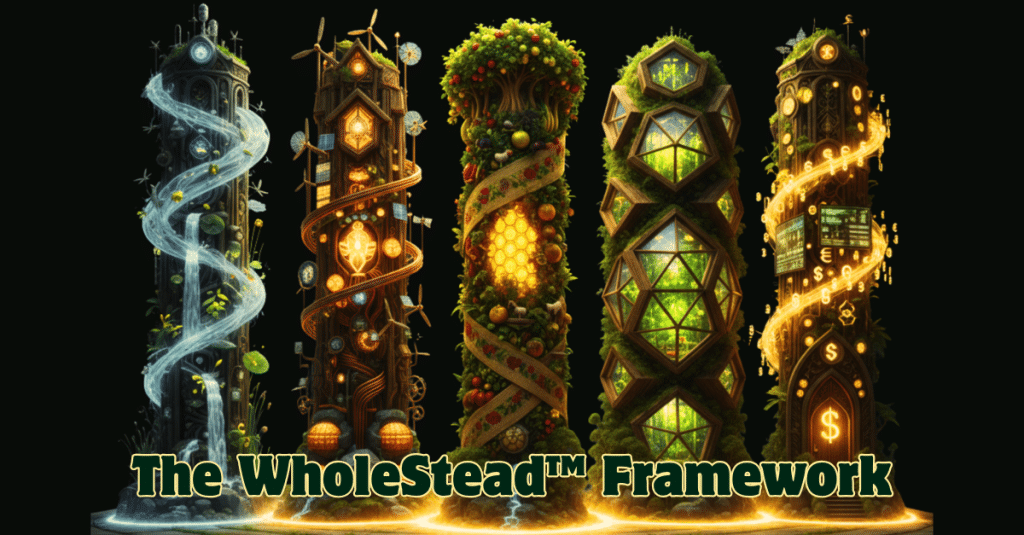
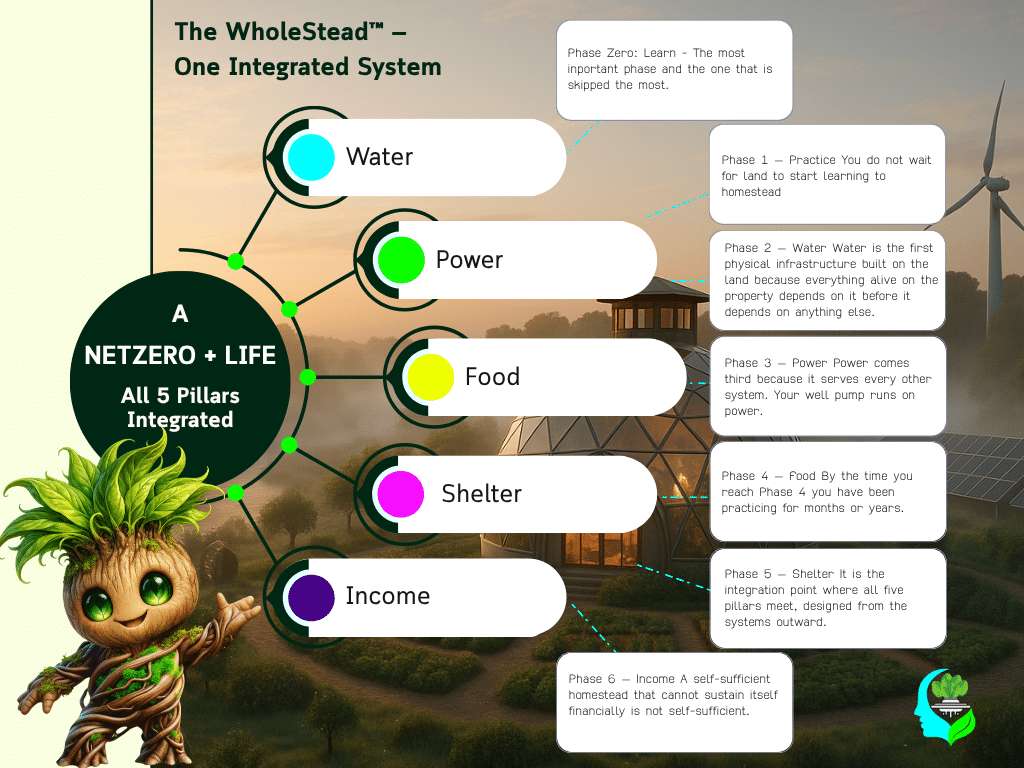
It is a five-pillar build sequence that maps every system a self-sufficient property needs, in the order those systems should be built. The five pillars are:
- Water — collection, storage, filtration, and distribution
- Power — generation, storage, and distribution
- Food — production, preservation, and sourcing systems
- Shelter — structure, insulation, heating, and systems integration
- Income — land-based and digital income strategies that sustain the whole
The order is intentional. Water first, because nothing else works without it. Power second, because once you know your water system’s demands, you can size your power generation to match. Food third, because a reliable water supply and stable power make food production consistent instead of a gamble. Shelter fourth, because a property with water, power, and food tells you exactly what your structure needs to support. Income last — because you build income on top of stability, not instead of it.
This is the sequence that prevents expensive mistakes. And it’s the spine of everything UpRooted Greens teaches.
But First — You Need to Know Where You Stand
Before you can build in the right order, you need to know what you already have, what you’re missing, and where your plan has holes. Most people skip this step entirely. They start with what excites them, not with an honest audit of what’s actually there.
That’s exactly what the complimentary 10-Point Homestead Vulnerability Assessment is designed to help you do. It walks you through all five WholeStead pillars and identifies the gaps in your current setup — the ones that will cost you the most if you don’t address them before you start building.
It’s not a quiz. It’s a diagnostic. And for anyone who’s ever bought seven trees without a plan, it’s the thing you wish you’d had first.
Every expensive mistake on a homestead has one thing in common: it was built out of order.
You can keep going the impulse-buy-seven-trees route. There’s nothing wrong with it, and the lessons are genuinely valuable. But if you’d rather spend that money on systems that last instead of on replacing the ones that didn’t — start with the assessment.
Take the free 10-Point Homestead Vulnerability Assessment. Find out which pillar in your plan is carrying the most risk right now. Then build from there — in the right order, for the first time.