
Small Space, Full System: How to Build Homestead Security on Less Than an Acre
Article 6 of 8 — The WholeStead™ Framework Series from UpRooted Greens
By Tihamtu Chaos-Dragon | UpRooted Greens
I have lived in an RV.
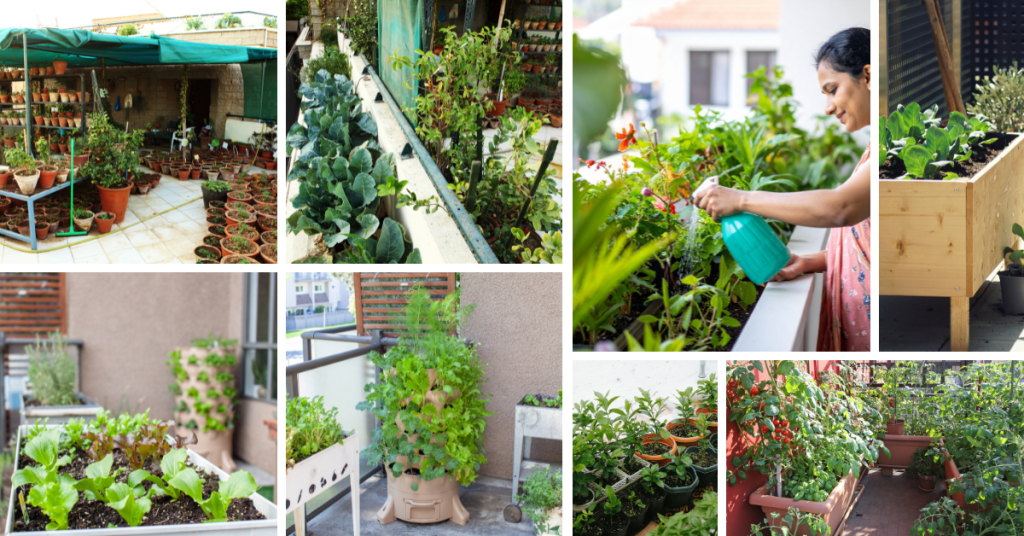
Not as a weekend adventure. As my home. And even then — even in that compressed, mobile, absolutely minimal space — I had plants. I have houseplants I have kept alive for decades. I have outdoor plants that have been thriving in the same large containers for over fifteen years. I have never stopped growing things regardless of how much space I had available, because growing things is not fundamentally a function of space. It is a function of intention and creativity and the willingness to think differently about the surfaces around you.
I have designed integrated growing systems for 8x8 foot balconies. I have also designed systems that span over a hundred acres. The principles that make both of them work are identical. The constraint of a small space does not eliminate the system. It concentrates it.
If you have been waiting for land before you start building toward self-sufficiency — if you have told yourself that your apartment, your rental house, your suburban yard, or your single balcony is not enough to matter — this article is a direct challenge to that belief. Not a gentle suggestion. A direct challenge. Because I have seen what is possible in eight square feet, and it is more than most people produce in a garden ten times that size because they never thought to look at every surface as a potential growing space.
The Only Thing Standing Between You and a Productive Small-Space System Is How You Are Looking at It
Traditional agriculture thinks horizontally. Rows of plants, stretching across flat land, spaced according to the width of a tractor or the length of a human arm. That model requires acreage because it is designed around acreage. It was developed for fields, not for the spaces most people actually live in.
Small-space growing thinks in all directions simultaneously. Horizontally, yes — but also vertically up walls, diagonally across trellises, overhead along ceilings and rooflines, and in layers stacked on top of each other with each layer serving a different function. When you shift from thinking about ground square footage to thinking about total cubic volume and every available surface, a small space stops being a limitation and starts being a design challenge with a surprising number of solutions.
We have an extraordinary range of growing methods available to us right now that previous generations did not. Hydroponics. Aquaponics. Vertical felt pocket walls. Tower gardens. Microgreens trays. Dwarf fruit tree varieties bred specifically for container growing. Compact animal breeds that produce meaningful quantities of eggs or meat in fractions of the space their standard-size counterparts require. More space gives you more options. But a small space, worked with full intention, gives you more than most people would believe before they see it in action.
The Balcony WholeStead™: A Complete Closed-Loop System in 64 Square Feet
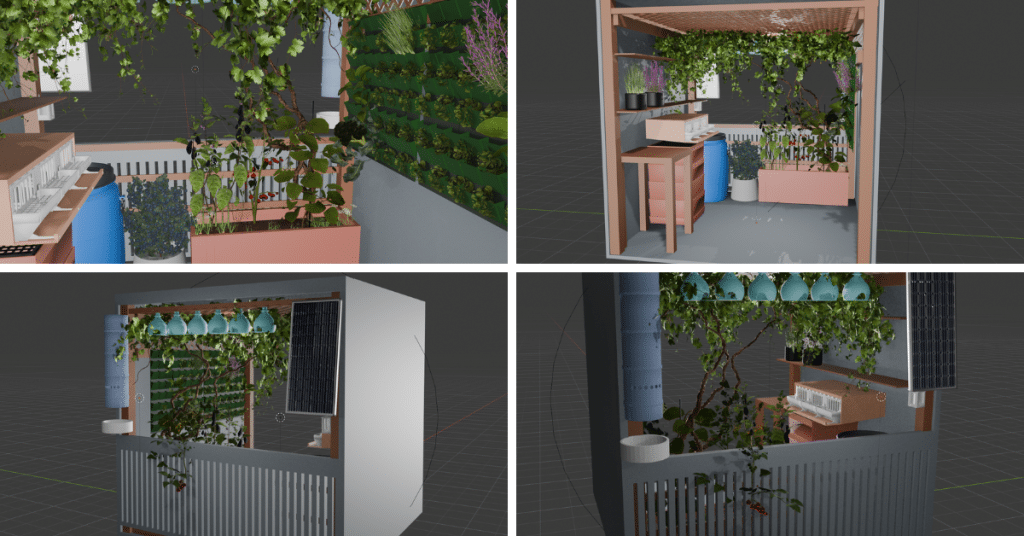
Let me walk you through what I have designed for an 8x8 foot balcony — because I think the fastest way to shift how you see your own space is to show you what complete integration looks like at the smallest possible scale.
This is not a thought experiment. Every element of this system is real, available, and achievable with standard materials and a modest budget. It produces compost, meat, eggs, salad greens, herbs, fruit, root vegetables, and microgreens. It captures rainwater and recirculates it through the growing systems. It generates a portion of its own power. And it fits on a balcony most people would describe as small.
The Protein Engine: A Quail Clutch
Start with six quail — a small clutch that fits comfortably in a raised cage with a mesh bottom. Quail are extraordinarily compact producers. They begin laying at six to eight weeks old, lay nearly daily, and require a fraction of the space that chickens need. Six hens produce enough eggs to supplement a small family’s protein needs meaningfully and, if you choose a meat breed like Coturnix, provide periodic meat harvests as well.
The mesh bottom of the cage is not just a structural choice — it is a systems choice. The quail manure falls directly through the mesh into the system below, removing it from the birds’ living space (which keeps them healthier and reduces smell) and routing it immediately into the fertility cycle.
The Fertility Engine: A Worm Compost Bin
Directly beneath the quail cage sits a worm composting bin. The quail manure drops in. Your kitchen scraps go in. The worms process both into castings — one of the most nutrient-dense, biologically active fertilizers available to any gardener at any scale. The worm bin is odor-controlled when managed correctly, produces liquid fertilizer as a byproduct, and requires no external inputs beyond your own food waste and the quail’s natural output.
This single connection — quail above, worms below — closes the most fundamental loop in any food system: the cycle from animal waste back to plant fertility. On an 8x8 balcony, you have just replicated in miniature what a farm’s entire composting operation does at scale.
The Water Engine: Rain Gutter and 55-Gallon Drum
A rain gutter along the balcony’s edge collects whatever precipitation falls on your footprint and channels it into a 55-gallon drum. Even in a climate with modest rainfall, this captures meaningful water that would otherwise be wasted. A small submersible pump inside the drum — powered by the solar panel mounted to the railing — automatically waters the floor-level planters and fills the hydroponic reservoirs for the green walls on a timer. The water system is closed: what the plants do not use returns to the reservoir. What evaporates is replaced by the next rainfall.
The Floor Level: One Long Planter, Multiple Yields
Along the balcony railing runs one long container: four feet long, eighteen inches wide, eighteen inches deep. That volume of soil, enriched with worm castings from the bin below the quail, supports a dwarf fruit tree at one end, a fruiting vine — a compact grape, or a Goji berry trained to grow vine-like along the railing, which it does naturally with its long willow-like canes — and a mix of root vegetables and companion flowers filling the remaining space.
This one planter produces fruit, vine fruit, root vegetables, and the insect habitat that comes from companion flowers — all from four linear feet of floor space along a rail that would otherwise hold nothing.
The Wall Opposite the Quail: A Living Hydroponic Green Wall
The wall opposite the quail cage is covered floor to ceiling in felt pocket planters on a hydroponic drip line fed from the drum below. The layout, from top to bottom, is intentional:
- Top row: melons, trained upward and tagged to the ceiling with small mesh baskets supporting the developing fruit as it grows across the overhead space. The ceiling becomes a canopy of food.
- Second row: strawberries, cascading out of their pockets and producing continuously through the growing season.
- Remaining rows: salad greens, culinary herbs, broccoli with light support, and whatever else the household uses most regularly in the kitchen.
This wall alone produces daily salad, herbs for cooking and preservation, fruit, and brassicas — from a surface that in most homes is completely bare.
The Remaining Surfaces: Nothing Wasted
The system is not finished at the walls and floor. Every remaining surface has a function:
- A small solar panel mounted to the railing powers the pump, the timer, and any lighting needed for year-round growing. Off-grid power at balcony scale costs very little and returns that investment within a season.
- A bat house on the exterior wall provides natural insect pest management. A single bat consumes hundreds of insects per hour. This is free, silent, and completely self-managing pest control.
- A row of purple martin houses along the front roofline edge under the water gutters adds a second tier of aerial insect management and, in regions where purple martins nest, draws colonies that will return season after season.
- A small set of shelves next to the door grows microgreens on a rotation: seeded, harvested within two weeks, reseeded. Microgreens are among the most nutrient-dense foods per square inch of any growing method available, and they require no outdoor light, no significant space, and minimal investment.
- A second shelf unit above the quail cage holds equipment, tools, additional containers, and whatever else the system needs in storage — keeping the working space organized without sacrificing a single inch of productive surface.
What this 8x8 system produces: compost, worm castings, liquid fertilizer, eggs, meat, salad greens, herbs, broccoli, fruit, vine fruit, root vegetables, strawberries, melons, and microgreens. It manages its own water. It generates its own power for the systems that need it. It manages its own pest pressure biologically. It is a complete, closed-loop food system in the footprint of a generous parking space.
From Balcony to Backyard: How the System Scales
The balcony system is not a compromise version of homesteading. It is the distilled logic of the WholeStead™ Framework applied to the smallest viable scale. Every principle that makes it work — closed-loop fertility, vertical growing, water capture and recirculation, integrated animal and plant systems, biological pest management — applies identically at every larger scale. More space gives you more of the same loops running in parallel, not a fundamentally different system.
A suburban backyard of a quarter acre can run the same loops at expanded scale: a larger quail colony or a small chicken flock, a proper compost system supplemented by a vermiculture bed, a cistern system fed by roof gutters, vertical growing walls on every fence line, a food garden in raised beds enriched by the animal fertility system, and a small food forest of dwarf and semi-dwarf varieties along the sunniest edge of the property.
A half-acre suburban lot adds the capacity for a small greenhouse, a larger water storage system, full-size fruit trees in the ground, and the beginning of a perennial food forest that will produce for decades. Each additional increment of space adds capacity, not complexity. The system you learned to manage on the balcony already contains all the thinking you need for any of these scales.
Inside the Walls: When Outdoors Is Not Available
For those who do not have a balcony, or whose balcony is not suitable for growing, the system moves indoors. This is not a lesser version of the approach. It is a different expression of the same logic.
A large quail colony can be established in a dedicated closet. Properly ventilated, managed with a mesh-bottom cage over a collection system, and lit on a controlled schedule, a closet quail colony can produce enough eggs to generate meaningful income from sales, in addition to supplying the household. Quail are quiet enough for apartment living — a lesson I learned from the Guinea fowl experience in the opposite direction. They are manageable, productive, and compact in a way that very few other livestock animals are.
Indoor walls support felt pocket systems under grow lights. South-facing windows support deep container growing with no supplemental light. Shelving units near any window become microgreen production stations. A spare bathroom with a grow light becomes a seed-starting operation that extends your effective growing season by months in either direction.
With proper preparation — grow lighting, reflective surfaces, and the right varieties selected for low-light tolerance or compact growth habit — every single interior wall of an apartment can be a producing garden. Not every wall needs to be. But the point is that none of them have to be empty by default. Each one is a choice.
The Real Constraint Is Never the Space
After designing systems at every scale from an 8x8 balcony to over a hundred acres, here is what I know with complete confidence: space is never the binding constraint. The binding constraints are always the same three things, regardless of how many square feet you are working with.
- How you are thinking about the space. Traditional horizontal thinking wastes most of the available volume in any small space. Three-dimensional thinking — walls, ceilings, vertical surfaces, layered systems — multiplies your effective growing area several times over without adding a single square foot.
- Whether the systems are integrated or isolated. Five separate containers growing five separate things produce far less per square inch than five elements of an integrated system where the waste from one becomes the input for another. Integration is what makes the 8x8 balcony produce at the level it does. In isolation, each component would produce a fraction of what the whole system produces together.
- Whether you have started yet. The most common reason small-space growing does not happen is not lack of space. It is waiting for more space before beginning. Every month you wait for a bigger space is a month of production, learning, and system development that you are not banking. Start in the space you have. Scale into the space you acquire.
More space is simply more things you can do. A small space means you need to be more strategic. That is not a disadvantage. Strategy, applied to any constraint, is where the most interesting and most durable solutions come from. The WholeStead™ Framework at balcony scale is more elegant, more tightly integrated, and more instructive than the same framework applied to fifty acres — because the constraint forced out everything that was not essential and kept only what works.
Your Space Is Enough to Start. Here Is What to Do Next.
If you made it through this article, something shifted. Maybe you looked at your balcony differently. Maybe you thought about the closet you are not using, the south-facing wall in the living room, the shelves next to the door that currently hold shoes. Maybe you started doing the math on what six quail could produce in the corner of a spare room.
That shift in perception is the beginning. The space you have right now is enough to start practicing the WholeStead™ Framework at a scale that costs you almost nothing and teaches you everything the full-scale version will eventually require of you. Every system you build in your current space, however small, is the foundation the larger one will stand on.
The one question worth answering honestly before you begin: of the five homestead systems — food, water, power, shelter, income — which one is most absent from your current setup? Because that gap is where to start, regardless of your square footage. Your specific vulnerability is yours alone, and the right first move depends entirely on what it is.
The free 10-Point Homestead Vulnerability Assessment inside UpRooted Greens is designed to answer that question clearly. It walks you through all ten critical homestead systems and shows you, in plain terms, where you are solid and where the gaps are — so that your first move is the right one, whether you are starting on a balcony or a backyard.
Take the free 10-Point Homestead Vulnerability Assessment
uprootedgreens.com
About the Author
Tihamtu Chaos-Dragon is the founder of UpRooted Greens, a total self-sufficiency education platform built around the WholeStead™ Framework. She has lived in an RV, kept houseplants alive for decades, grown food in containers for over fifteen years, and designed integrated growing systems for spaces ranging from 64 square feet to over a hundred acres. Her conviction is simple: the space you have is enough to begin. Everything else is strategy.