
Off-Grid Homestead: Financing Determines Buying vs Building Path
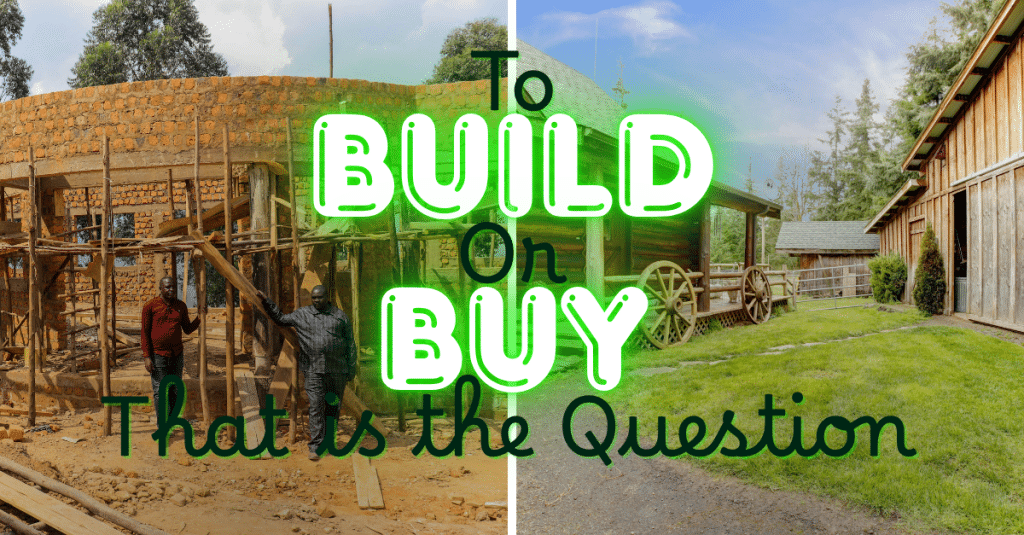
Most buyers choose between purchasing an off-grid homestead or building from scratch based on vision and price tags. But there’s one financial variable that actually determines which path leads to success, and another that causes more failures than everything else combined.
Key Takeaways
- Your financing type – not your vision – is the single variable that determines whether buying or building an off-grid homestead makes more sense.
- Existing off-grid properties are frequently failed homesteads in disguise; outdated systems, bad site placement, and unpermitted structures are common and costly traps.
- Tighter budgets do better buying a mortgageable, grid-tied property and converting gradually – capital-rich buyers get a lasting advantage building from raw land.
- Water infrastructure is the first thing to price on any property – it’s the number-one reason homesteads fail, regardless of which path is taken.
- Before committing to either path, a structured vulnerability assessment – like the 10-Point Homestead Vulnerability Assessment from UpRooted Greens – can surface the hidden risks most buyers and builders overlook.
The off-grid homestead dream is vivid and specific: morning chores before sunrise, a garden that actually feeds the family, power that runs whether the grid does or not. What’s less vivid – but far more decisive – is the financing reality sitting underneath that dream. That one variable shapes every decision that follows.
Your Budget – Not Your Dream – Decides the Path
When comparing an existing homestead’s purchase price against a ground-up construction invoice, buying almost always looks cheaper on paper. Sellers of off-grid property rarely recover what they spent on wells, solar arrays, outbuildings, and fencing. On the surface, it looks like buying discounted infrastructure.
The real question is which path delivers a working, sustainable homestead for the least total money, risk, and heartbreak. Framed that way, the answer splits along one variable: how much capital is available and how it can be deployed. Significant capital favors building from raw land – every system goes in the right place, designed correctly from day one. A tighter budget favors buying a property a bank will finance and converting it gradually. What sits awkwardly in the middle – purchasing an existing off-grid homestead – deserves its own honest look.
The Hidden Problem With Existing Off-Grid Properties
Before falling for the listing photos, ask the question almost no buyer asks: why is a working homestead for sale? Sometimes it’s age, health, or relocation. A significant share of off-grid properties on the market, though, are failed attempts – someone who bought the dream, placed systems wherever seemed convenient, and discovered three years later that the well ran dry every August, the solar array was shaded half the year, and the cabin was framed without a permit.
Failed Homesteads Disguised as Head Starts
These sellers aren’t offering a head start – they’re offloading unsolved problems staged to look like one. The most dangerous of those problems is almost always water. A property can look magnificent in June and be functionally dead by September. Buying someone else’s off-grid property carries a real chance of inheriting the exact water failure that broke them – and it won’t appear in any listing photo.
What “Existing Infrastructure” Is Actually Worth
Valuing off-grid systems honestly changes the math on most listings:
- Aging solar systems: A ten-year-old array with early-generation lead-acid batteries is often worth less than nothing. Lead-acid battery banks over 3-5 years old are typically liabilities, not assets – disposal costs money before any new lithium system goes in.
- Undocumented structures: Owner-built buildings without permits, unpermitted septic, and DIY electrical can block conventional financing entirely and make insurance quotes brutal. That’s exactly why these properties sell cash-only at a discount – and the discount is real, but so is the reason for it.
- Permanent placement mistakes: If the house sits at the bottom of the slope, the barn is uphill of the well, or the garden is 400 feet from the water supply, no retrofit budget fixes the layout. Those mistakes become decades of extra labor, pumping costs, and contamination risk baked into the site plan.
- Due diligence still costs money: A proper evaluation – well flow test, water quality panel, septic inspection, solar load test, structural inspection – runs $1,500-$4,000. Skipping it to save money is how buyers end up with $60,000 problems.
The rule of thumb: value the land and any permitted, insurable structure at market rate. Value every off-grid system at a steep discount – often near zero – until it passes independent testing. If the property still pencils out under that math, it can be a genuine bargain. Most don’t.
Financing Reality by Property Type
Here’s the part of the buy-vs-build decision that dwarfs the cost of any tank or turbine: what kind of money is available, and what does it cost?
Conventional Mortgages: The Cheapest Money Available
A grid-tied house on acreage can be financed with a conventional, FHA, USDA, or VA mortgage – typically 0-20% down at standard residential rates. That’s the cheapest borrowing available to most people. Conventional lenders require properties to have access to approved utility systems (like wells and permitted septic) and structures that meet local building codes. Anything unpermitted or without standard utilities usually disqualifies the property entirely.
Raw Land and Construction Loans: Higher Cost, Higher Bar
Raw land loans typically require 20-35% down, carry interest rates at least 1 point above standard mortgage rates, and come with shorter repayment terms. Construction-to-permanent loans are more flexible for new builds but generally require a licensed builder and approved plans. Some rural development loan programs can accommodate non-traditional utility setups – provided specific health and safety standards are met – but they’re the exception, not the rule.
Cash-Only Off-Grid Sales: The Discount and the Reason
Unpermitted off-grid dwellings and properties without conventional utilities typically require cash, seller financing, or hard money lending. Seller financing terms vary wildly; hard money is expensive. The cash-sale discount is real – but it exists because institutional lenders won’t touch the property. That’s the market pricing in the risk correctly.
Tighter Budget? Buy Mortgageable, Convert Gradually
For anyone working with limited capital, the lower-risk path is clear: buy a property a bank will finance – which in practice means land with an existing grid-tied dwelling – and treat the grid as a temporary training wheel. This removes the most dangerous gap in homesteading: the stretch between spending the money and having a livable, functioning property. There’s shelter, water, and power on day one at a fixed monthly cost, while off-grid systems get built in the correct order as cash allows.
The original house doesn’t have to remain the permanent home. Many successful conversions eventually build a purpose-designed, super-insulated structure elsewhere on the property and repurpose the original as a farm store, workshop, or processing space. A grid-tied building with plumbing and 200-amp service is an extremely useful outbuilding. Independence then gets bought one system at a time – rainwater catchment this year, a starter solar array next, a well the year after – until the grid shifts from primary to backup to optional.
Have the Capital? Build It Right, Once
Deploying $150,000-$400,000+ over a build period (depending on region and ambition) makes raw land the superior long-term investment. The reasons are structural.
Placement Decisions That Can’t Be Undone
Water systems go uphill of use points so gravity works for free. The house orients for passive solar gain and cross-ventilation. The garden sits within a hose-length of the kitchen. The barn sits where prevailing winds carry smell away from the house and runoff away from the well. These decisions cost nothing at design time and are nearly impossible to fix afterward. A super-insulated, correctly oriented structure also needs a fraction of the energy of a conventional one – fewer panels, fewer batteries, smaller backup systems. That efficiency can only be built in, not retrofitted.
The Temporary Housing Cost Builders Must Budget
The full foundation – water, power, septic, access, and a dried-in shell – must be funded before the property is livable. Budget for temporary housing: an RV or travel trailer runs $8,000-$40,000 (partially recoverable at resale), and the unlivable phase typically lasts 8-18 months even on an aggressive schedule. Skipping this line item in the budget is one of the most common builder mistakes.
Water: The System That Decides Everything Else
Water comes before power, before food, before the roof. It’s the number-one reason homesteads fail, and the first thing to price on any property – existing or raw.
Well Drilling Costs and the Yield Risk Nobody Warns You About
A drilled well is the gold standard of homestead water, but it carries real risk. National 2026 rates run roughly $25-$35 per foot in soft sediment and $50-$75+ per foot in hard rock. A typical 150-300 ft residential well comes in between $5,500 and $18,000 fully equipped – drilling, casing, pump, pressure tank, trenching, electrical, and permits. Specifying a 6-inch casing over the cheaper 4-inch adds cost but allows both a submersible pump and a hand pump on the same wellhead, preserving water access during power outages.
Drillers charge by the foot whether or not they hit water – and hitting water doesn’t guarantee potable water. Sulfur, iron, arsenic, and salinity all happen. Pull your state’s well completion database and study neighboring wells for depth, yield, and quality before drilling or buying. For existing properties, a flow test during the driest month possible, plus a full lab panel ($150-$600), is non-negotiable.
Rainwater Storage: Concrete vs. Plastic Trade-Offs by Situation
Every serious homestead should harvest rain regardless of primary water source. Every inch of rain on 1,000 square feet of roof yields about 620 gallons. The biggest cost variable is storage. Poured concrete or ferrocement cisterns run $0.30-$0.75 per gallon ($3,000-$7,500 for 10,000 gallons) and last 50+ years – they never freeze solid and eliminate UV degradation, offering strong long-term value per dollar of storage. Corrugated steel tanks with liners ($0.40-$0.85 per gallon) are the above-ground size-for-money champion where excavation isn’t practical. Poly tanks ($0.50-$1.20 per gallon) are fast and easy at small sizes but degrade under UV and get expensive in large capacities. One important detail: asphalt shingle roofs are not recommended for potable rainwater collection, as they shed petroleum compounds and other contaminants that standard home filtration may not fully address. Potable catchment requires a metal, clay tile, or concrete tile roof surface.
Power: Solar and Wind by Default, Hydro When the Land Allows
Why Micro-Hydro Transforms the Math If You Have Moving Water
If a stable, year-round stream exists on the land with legal diversion rights, micro-hydro is the primary power source. A hydro system producing a steady 1 kW delivers 24 kWh every single day, around the clock – it takes a solar array roughly 5-6 times that size to match it with good sun exposure. Continuous generation also nearly eliminates the battery bank, which is the most expensive, shortest-lived component of any off-grid system. Turgo and Pelton turbine units run $300-$3,000; complete DIY systems commonly land at $2,000-$10,000; professionally engineered installations range from $10,000 to over $50,000 depending on system size and site complexity. Measured against decades of round-the-clock output, nothing else competes per lifetime kilowatt-hour. Always verify water rights and permitting before buying land around a stream – especially in the western U.S., where diversion restrictions can apply even to systems that return every drop.
Solar Cost Tiers for 2026 (30% Federal Tax Credit Expired December 31, 2025)
Solar remains the flexible default for most homesteads. 2026 pricing by tier:
- Starter (1-2 kW + small battery): $6,000-$10,000 DIY – lights, fridge, freezer, electronics, well pump in bursts
- Mid (5-6 kW + 10-15 kWh battery): $15,000-$25,000 DIY / $20,000-$40,000 installed – a frugal, efficient household
- Full household (10-15 kW + 20-40 kWh battery): $30,000-$60,000 DIY / $50,000-$100,000+ installed – normal American consumption including shop tools and some HVAC
The federal 30% residential solar tax credit expired December 31, 2025, so 2026 buyers should price systems at full cost. That shift tilts the math further toward DIY installation and toward reducing energy load before sizing the array. LiFePO4 batteries run roughly $400-$900 per usable kWh – the line item that punishes oversized lifestyles most severely. Where wind averages 9-12+ mph sustained, a small wind turbine ($3,000-$15,000 with tower) pairs well with solar by generating through nights and gray-weather periods, often reducing the required battery bank size enough to offset the turbine’s cost.
Food Infrastructure Costs Everyone Underestimates
A family of four consumes roughly 2,000-3,000 pounds of vegetables, fruit, and staples a year. Feeding them meaningfully from the ground requires real infrastructure: a canning setup ($300-$800), chest freezers ($400-$900 each plus their permanent load on the power system), root cellar storage ($500 DIY to $10,000+ built), and potentially a dedicated processing space if any sales income is part of the plan. Fruit and nut trees, berry canes, and hedgerows go in during year one – they take 3-7 years to mature, and every delayed season is a season added to the end of the payoff.
Why a Greenhouse Delivers Outsized Value in Most Climates
A greenhouse or high tunnel is a workhorse, not a luxury. It extends the growing season on both ends, starts every transplant on the property, overwinters tender perennials, dries harvests, and in cold climates can shelter animals or brood chicks through shoulder seasons. High tunnel kits run $2-$8 per square foot ($500-$7,000 for useful sizes); glazed greenhouses cost more. The USDA NRCS EQIP high-tunnel cost-share program routinely covers a significant portion of the cost for qualifying producers – one of the most accessible subsidies available to small homesteads and worth researching before budgeting this line item.
Your Financing Type Is Your Strategy – Choose the Path That Matches It
The buy-vs-build debate looks like a lifestyle question on the surface. Underneath, it’s a finance question with a clear, logical answer based on available capital. A limited budget with financing access points toward a mortgageable property with a gradual off-grid conversion. Significant deployable capital points toward raw land and a ground-up build designed for NetZero+ performance from day one. Both paths work – but only when matched to the money that actually exists, not the money that would be convenient. Get the financing type right, and the strategy practically writes itself.
For anyone ready to stress-test their plan before committing, UpRooted Greens helps aspiring homesteaders build financially grounded, resilient off-grid systems – from water and power to food and land strategy.