
Build Your Homestead Income First: Why the Money System Should Come Before the Garden
Article 7 of 8 — The WholeStead™ Framework Series from UpRooted Greens
By Tihamtu Chaos-Dragon | UpRooted Greens
I want to tell you where I am building from. Not to ask for your sympathy — I have not needed that for a long time. But because the argument I am about to make about income planning only makes full sense when you understand the ground it was built on.
I have been on Social Security Disability Income since 2002. When I first received it, the total was slightly under $700 a month. Twenty-some years later, it is slightly under $900. That is what I have had to build on: less than $900 a month, covering housing, food, utilities, and every dollar that has gone toward building UpRooted Greens — the curriculum, the tools, the livestock experiments, the aquaponics, the hydroponics, the garden, and ten years of working toward a homestead vision so detailed I can describe the geothermal tubing under the floor.
The reason I was placed on disability is a story worth telling because it is part of what UpRooted Greens was built to address.
I grew up in a home defined by severe abuse. My father’s discipline, from ages three to seven, involved chasing me down a hallway while he folded his belt between his hands and snapped it — slowly, deliberately — while I ran screaming until the hallway ended. After seven, he graduated to throwing me across rooms into walls, and down stairs, and back up the stairs, and down again. What that kind of childhood teaches a child, at the neurological level, is that no is not a word available to her. I was in my thirties before I fully understood that I was allowed to say it.
My mother believed I was either possessed by the devil or his child. When I was fifteen, she sought a court-ordered exorcism. They asked me if I wanted one. I said no. That was the first recorded moment in my life where I exercised sovereignty over my own existence.
I ran away from home at thirteen, after being raped twice within three months by two different men. My father had spent my entire childhood training me that men were monsters who would terrorize and then hurt you if you did not comply. That training did not protect me. It made me unable to protect myself. I left at thirteen and did not look back.
My parents also spent my childhood convincing me — and training my brain to believe — that I was schizophrenic. Every difficult experience I reported was dismissed as hallucination. Every perception that did not serve their narrative was labeled a symptom. When I eventually ended up in psychiatric care, my brain had been so thoroughly conditioned to produce the symptoms they had named that trained psychologists could not distinguish it from the real diagnosis. I was classified as schizoaffective, then paranoid schizophrenic, and placed on disability accordingly. I did not learn until eight years ago that what I actually had was complex PTSD — the entirely predictable neurological response to years of severe, sustained childhood trauma.
The clarity came from an unexpected direction. I took salvia — legally, at the time — and had my first genuine hallucination. The thought that followed was quiet and completely world-altering: “If that was a hallucination — I have never had one of those before.” It took three years for the full weight of that to settle. But when it did, the healing began.
My IQ tested at 149 while I was in the psychiatric ward. I had spent my entire childhood being told my mind was broken, by the very people who had broken it, while that mind was quietly doing what minds like mine do: observing everything, connecting everything, building frameworks for understanding the world that no one around me seemed to share or even notice. I did not get along with other children because they seemed to not think about anything. Adults seemed smarter, until I got older and realized that was not entirely true either.
I have been taking care of myself since I was five. I have been fully responsible for my own survival since I was thirteen. I have not spoken to my parents in over twenty years, and that distance is the single most important factor in my recovery. I have thirty years of college education, four or five degrees, and fifteen additional years of self-directed study and training. I have done exactly what I wanted to do with my life — from the moment I left my parents’ house and started making my own decisions — and what I have wanted to do is learn everything, build systems, and figure out how to live independently in a world that had given me almost no foundation to stand on.
That is where UpRooted Greens comes from. Not from a comfortable homestead with a good start. From the absolute bottom — from a place so far down I did not know there was something else — built by someone who refused, through everything, to stop.
I am telling you this because this article is about income planning, and I want you to understand that the argument I am about to make was not developed in theory. It was developed by someone who has spent twenty years building toward a vision on less than $900 a month, who understands in her bones what it costs to not have an income system designed into the plan from the beginning, and who built an entire educational platform so that no one else has to figure out the hard way what she had to figure out alone.
The Contrarian Case: Why Income Planning Comes Before the Garden
Every homesteading resource you have ever read sequences income last. Build the food system. Build the water system. Build the power system. Build the shelter. Then, once everything is established, figure out how to make the homestead pay for itself.
That sequence kills more homestead dreams than any other single factor. I have watched it happen repeatedly, and I have lived a version of it myself. When income is the last thing you plan, it is always the thing that runs out first.
Here is the logic that the conventional sequence ignores: every phase of your homestead build consumes capital before it produces any. Land costs money before it grows anything. Infrastructure costs money before it stores a drop of water or generates a watt of power. A food garden takes months to produce and years to reach the level of output you planned for. Livestock requires housing, feed, and management before it produces a single egg or a pound of meat. The entire build is a long series of expenditures against a future return — and if you do not have an income system generating revenue during that period, you are spending down whatever savings funded the project until it runs out.
When the savings run out, the homestead stops. Not because the vision was wrong. Not because the person was not committed. Because the financial architecture was not built to sustain the timeline the build actually requires.
Income planning does not belong at the end of the WholeStead™ Framework. It belongs at the beginning — in Phase 0, alongside every other piece of foundational learning — because every physical decision you make from that point forward should be shaped by how the homestead is going to sustain and eventually fund itself.
Why This Matters Most for the People with the Least
The homesteading content world skews heavily toward people who already have some financial foundation. People with savings, with equity, with a working spouse’s income, with family land, with an existing business that can absorb the homestead’s early losses. Those people can afford to sequence income last because they have runway built in.
The people I am building UpRooted Greens for do not have that runway. They are on fixed incomes, disability payments, minimum wage jobs, or no income at all. They are single parents. They are people who have been told by every system around them that self-sufficiency is not available to them because they do not have enough to start with.
For those people, income planning is not a nice addition to the homestead plan. It is the load-bearing wall. Without it, nothing else holds. And for those people — for us, because I am one of us — the income system has to be designed before the first seed is purchased, because the income system is what makes the seeds possible.
I began building UpRooted Greens because I first thought I was creating a pathway for other people on disability to build income and eventually build toward independence. Then I realized something larger: if I documented everything I had learned across thirty years of formal education and fifteen years of self-directed study, organized it around my passion for independence and self-sufficiency, and built it into a curriculum anyone could follow from wherever they were starting — that was not just a business. That was a different world being offered to people who had been told no world like that was available to them.
That is still what it is. And it started with income planning.
What “Income First” Actually Means in the WholeStead™ Framework
Income first does not mean you build an income system before you build anything else on the homestead. It means you plan the income system before you build anything else. The distinction matters because planning costs nothing and building costs everything.
In Phase 0 of the WholeStead™ Framework — the learning phase, the planning phase, the phase that costs you time and attention rather than capital — your income architecture is one of the primary things you are designing. Before you choose your land. Before you select your crops. Before you decide where the structures go. You are answering the question: how does this homestead sustain itself financially, and what does that mean for every other decision I make?
That answer shapes everything downstream. If your income stream is a farmers market presence, your crop selection prioritizes high-value, high-volume market crops alongside your family’s food production. If your income stream is an educational platform built on your homestead journey, your documentation and content production start on day one — because your process is the product. If your income stream is agritourism or workshops, your property layout accounts for visitor flow from the first time you put anything in the ground.
A homestead designed with income in mind from the beginning looks different from one where income was added later. It produces differently. It uses its land differently. It prioritizes different crops in different quantities. It builds structures that serve both the family and the income streams simultaneously. The integration is designed in, not bolted on, and it costs a fraction of what retrofitting costs.
The Income Layer Architecture: Building Revenue That Compounds
A single income stream from a homestead is fragile. One bad season, one market that closes, one crop that fails — and the financial layer collapses. The WholeStead™ income architecture is layered, with each layer generating revenue on a different timeline, from different outputs, with different failure modes, so that no single disruption takes the whole system down.
Layer 1: Immediate Production Income
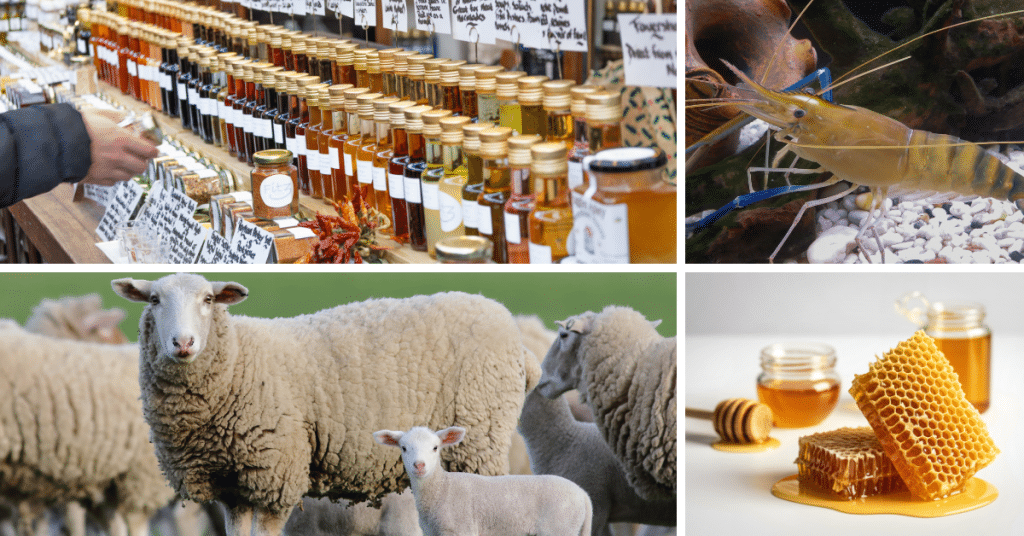
This is the income that comes from selling what the homestead produces directly: eggs, meat, produce, cut flowers, seedlings, seeds, honey, dairy products, value-added preserves and ferments. It starts small and scales with the production systems. It is the most visible homestead income and the one most people think of first — but it is the least stable layer on its own, because it is weather-dependent, season-dependent, and requires physical presence and physical output.
Design your cash crops alongside your food crops from the beginning. The highest-value crops per square foot — specialty herbs, microgreens, edible flowers, medicinal plants, high-demand vegetables with short growing windows — often require no more space or labor than the standard garden crops they sit alongside. The difference between a food garden and a cash-producing garden is frequently just the selection, not the space.
Layer 2: Value-Added and Skill-Based Income
This layer converts the homestead’s raw outputs into higher-margin products and the homesteader’s knowledge into teachable value. Dried herbs sell for more than fresh ones. Tinctures sell for more than dried herbs. Workshops on how to make tinctures sell for more than tinctures. The same knowledge, packaged at progressively higher levels of process and accessibility, generates income that is not dependent on any single harvest.
Teaching is one of the most underutilized income streams in the homesteading space. If you have learned something that others need to know — and if you are building a WholeStead™, you are accumulating exactly that kind of knowledge every single season — that knowledge has monetary value independent of whether your garden had a good year. Workshops, consulting, mentoring, and online courses can all generate income during the months when production is slow or during the years when the land is still being established.
Layer 3: Digital and Documented Income
This is the layer with the highest leverage and the longest build time: digital products, online courses, content platforms, and documented knowledge that generates revenue independent of your physical presence or your seasonal production. A course you build once continues generating income while you sleep, while you harvest, while you expand the garden, and while the land you planted five years ago matures into the food forest you designed in Phase 0.
This layer is exactly what UpRooted Greens is. Over 320 courses documenting every system in the WholeStead™ Framework, built on ten years of learning and experimentation, generating income that funds the physical homestead build it was designed to support. The digital layer was not an afterthought. It was the income system designed in Phase 0 that made everything else possible on less than $900 a month.
You do not need to build 320 courses. You need to document what you know, teach what you have learned, and build something that generates value independent of whether you personally showed up in the garden that day. Start small. Build consistently. Let it compound.
Layer 4: Legacy and Structural Income
This is the layer most people never reach because they stop before they get here — and the layer that makes a WholeStead™ truly permanent. Land agreements, trusts, licensing arrangements, agritourism infrastructure, community-supported agriculture contracts, and wholesale relationships that generate predictable, recurring revenue season after season regardless of market fluctuations.
This layer is planned in Phase 0 and built across Phases 4 through 6. It requires the physical homestead to be sufficiently established to deliver reliably, and it requires the legal and financial structures to be designed correctly so that the income it generates can be protected and passed to the next generation. It is not complicated. It is sequential. And it is only available to the homesteads that planned for it from the beginning.
Where UpRooted Greens Actually Began
I have a fantastic PTSD therapist. For the last several years she has been helping me work through the accumulated weight of a childhood that did everything it could to make me believe I was broken, evil, and incapable of determining my own reality. That work is ongoing. It is the most important work I do.
What I discovered in the course of that work — and in the three years after the salvia moment that cracked the misdiagnosis open — is that the things my childhood tried to break were actually the things that kept me alive and moving through all of it. The relentless need to understand systems. The refusal to accept that I was limited by what others said I was. The compulsion to learn everything and connect everything and build something from it. The complete unwillingness to stop.
I was babysitting other people’s children at age five because I was responsible and the adults around me were not. I have been taking care of something — myself, others, a garden, an animal, an idea, a platform — every single day of my life since before I was old enough for most children to do their own laundry. That is not a trauma response. That is a capacity. A large one.
I am building UpRooted Greens because I want a world where no child ever has to grow up the way I did. Not just protected from abuse — though that too — but genuinely equipped to be independent. To grow food. To generate power. To access clean water. To build shelter. To create income from their own knowledge and their own hands. To be sovereign in their own lives in a way that cannot be revoked by any external force, including the ones that are supposed to protect them and do not.
That is a large vision. Large visions require large planning. And the first piece of that planning, the piece that makes all the rest possible, is the income system that funds it while it grows.
The Garden Can Wait One Season. The Income Plan Cannot.
If you have made it through this article, you have read something that most homesteading content will never tell you: that the income system is not the reward for building the homestead. It is the foundation the homestead is built on. And if you are starting with limited resources — as most people do, as I did, as I still am — that foundation is not optional. It is the only thing that makes the timeline survivable.
The question worth sitting with before you plant a single seed or purchase a single panel is this: what is your income architecture, and is it designed into your homestead plan or assumed to develop on its own afterward? Because assumed income is not income. It is hope. And hope, on a tight budget and a long timeline, is not enough.
The free 10-Point Homestead Vulnerability Assessment inside UpRooted Greens includes your income system in its evaluation — because we treat income as infrastructure, not afterthought. Take it before you commit to your next phase. Know where your gaps are. Build to close them.
Take the free 10-Point Homestead Vulnerability Assessment
uprootedgreens.com
About the Author
Tihamtu Chaos-Dragon is the founder of UpRooted Greens. She has been building toward a fully integrated, self-sufficient homestead on Social Security Disability Income since 2002 — less than $900 a month, ten years of development, 320+ courses, and a vision so detailed and so thoroughly planned that she can describe the heating system under the floor of a house she has not yet built. She started with nothing and kept going. UpRooted Greens exists so that the path she built the hard way can be traveled by everyone else the intentional way.