The WholeStead™ Framework from UpRooted Greens
By Tihamtu Chaos-Dragon | UpRooted Greens
The day I brought my Guinea fowl home, I was convinced I was making a smart move.
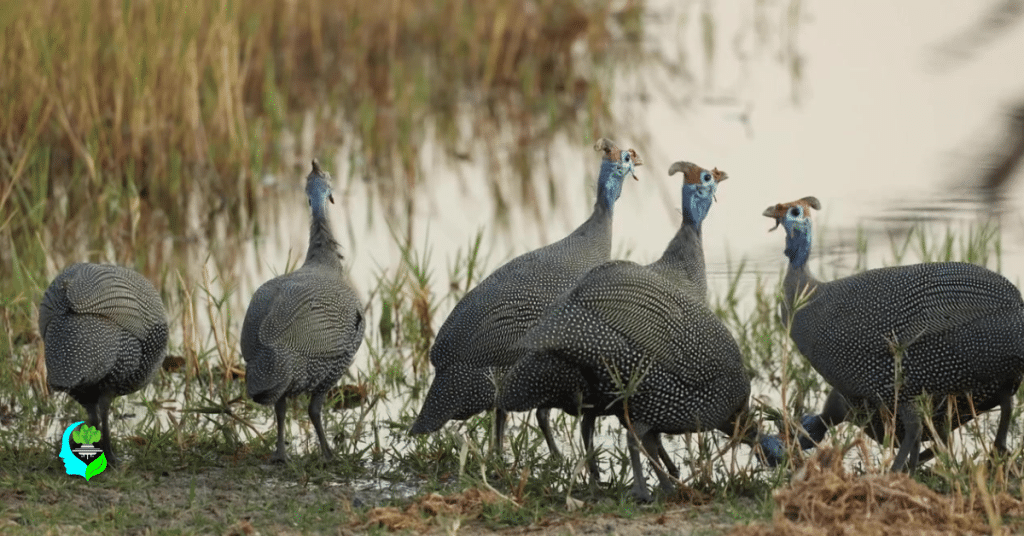
I live in a subdivision in town. My neighbors sit directly next to me — not across a field, not behind a tree line, right there. My plan was elegant in my mind: Guinea fowl are legendary tick and ant hunters. They would roam the neighborhood, quietly dismantling the red ant problem that had made my yard nearly unusable. My neighbors would thank me... eventually. The birds would pay for themselves in pest control alone.
Here is the honest version of what happened: people told me Guinea fowl were loud. Videos told me they were loud. I understood the word loud. What I could not account for, until I was living inside it, was the specific, penetrating, carry-two-blocks-in-every-direction quality of that sound. It was not my neighbors directly next to me who complained first. It was the neighbors on the other side of the block. People I had never met. I had to rehome the birds before they had eaten a single ant, I was sad however I will get them again when I have a much larger plot of land.
The following spring, I bought baby chicks. My reasoning seemed sound: I still had the Guinea fowl’s old enclosure — a large A-frame structure covered in hardware cloth with roosts inside. Surely the chicks could move into that when they outgrew their brooder. What I had not fully thought through was that the Guinea enclosure was only ever a night coop. No run. No cover from weather or predators. It was completely unsuitable as a chicken setup, and too small to serve as even a temporary run, for very long. So when the chicks outgrew the brooder, I had no workable intermediate housing. They went into a dog kennel for the nights and the guinea cage during the day while I built a full coop and run from scratch, under pressure, on a timeline the chickens had set for me.
I am not telling you these stories because they are funny, though they are. I am telling you because the Guinea fowl story is not a failure of research — I had done the research. It is a failure of internalization: there is a gap between knowing something intellectually and truly accounting for it in your planning. The chicken story is a failure of integrated thinking: I had a structure, I just had not thought it all the way through. Both kinds of failure are solved the same way: you plan the whole system completely before you commit to any piece of it.
Those small mistakes cost me time and money. On a real homestead, built around a real family, built on real land you have worked years to afford — the same class of mistake costs you years.
That is why the order matters. That is why I built The WholeStead™ Framework.
Why Sequencing Is the Skill Nobody Teaches
The homesteading space is full of excellent, well-researched, genuinely useful information. There are brilliant solar educators, master gardeners, water systems engineers, and livestock experts sharing their knowledge online every single day. The information is not the problem.
The problem is that none of them talk to each other. The solar blog does not reference your water needs. The gardening course does not account for your power situation. The water harvesting guide does not mention that your food production will triple your daily water demand. The livestock manual does not ask whether you have secured your shelter infrastructure first.
You are left to assemble five separate curriculums, written by five people who have never met, into a single functioning life. And because nobody has mapped the connections between these systems, most people build them in whatever order they can afford, whatever order excites them most, or whatever order the algorithm suggests that week.
Then they wonder why their homestead feels like it is always on the edge of collapse.
It is not a failure of effort. It is a failure of sequence.
What the WholeStead™ Framework Actually Is
The WholeStead™ is not a checklist. It is not a gear guide. It is not a list of things to buy in a specific order.
It is the recognition that a truly self-sufficient homestead is a single integrated system made of five pillars — Food, Water, Power, Shelter, and Income — and that these pillars are not independent projects. They are interdependent systems that feed each other, depend on each other, and fail each other when built without awareness of the whole.
A homestead with excellent food production and no reliable water source is a garden waiting to fail in a drought. A homestead with solar panels and no food system is an expensive campsite. A homestead with income streams and no shelter infrastructure is someone else's problem to solve while you live in it. Every pillar you build in isolation is a structure with no foundation.
The WholeStead™ Framework gives you the sequence — the order in which to learn, plan, practice, and build these five pillars so that each one you add strengthens the ones before it and prepares the ground for the ones that follow.
The Sequence: Eight Phases of a WholeStead™ Build
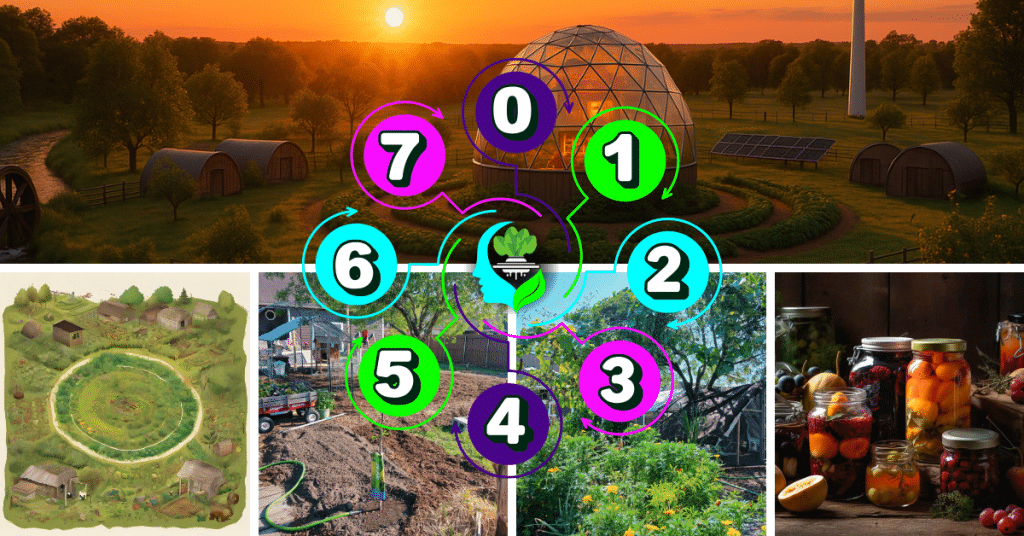
These phases are not arbitrary. Each one is positioned where it is because of what it enables, what it requires, and what it protects. Skipping phases is always possible. It always costs you.
Phase 0: Learn Everything First — Before You Buy a Single Thing
This phase has no budget line. It costs you time, attention, and the willingness to study before you act. It is also the phase that most people skip entirely — and the one that saves you the most money in every phase that follows.
Before I bought a single piece of land, I spent years learning everything I could about every system I planned to build. I did not learn them one at a time. I learned them simultaneously, which meant I could see the connections — where one system's output becomes another system's input, where one system's failure cascades into another system's collapse.
The Guinea fowl story is a Phase 0 failure. I had not learned enough about local ordinances, about my neighbors' tolerance, about the specific behavioral traits of that animal in an urban setting. A week of research would have saved me that mistake. Phase 0 is cheap. Every other phase is expensive.
What to do in Phase 0:
- Study all five pillars simultaneously, not sequentially
- Learn your local zoning laws, water rights, and building codes before you fall in love with a piece of land
- Research the specific animals and plants you plan to use in your specific climate and community setting
- Talk to people who have built what you want to build. Ask what they would do differently.
- Plan the whole integrated system on paper before you commit to any piece of it
Phase 1: Practice Where You Are Right Now
This is the most undervalued phase in the entire framework. Most people are waiting for their land before they start learning to grow food, keep animals, or build systems. That waiting is costing them years.
I started my garden before I bought my land. I am still in a subdivision in town. My garden did not produce anything meaningful for a year and a half. The soil had to balance. The bad bugs had to be displaced by good bugs. I had to learn what my specific microclimate does in summer heat, in early frost, in the wet season.
Now — after 18 months of patience and observation — my garden is producing abundantly. The naturalization process is complete. I know my soil. I know my bugs. I know my timing. I know what this particular piece of ground wants to grow. I didn't build that all at once either, it grew a bit bigger every season.
If I had waited for my homestead land to start this learning process, I would be 18 months behind right now — and those 18 months would happen at the worst possible time, when I have a mortgage on the land, construction happening around me, and a family depending on food production that has not yet learned how to produce.
Practice in Phase 1 looks like:
- Starting a container or raised bed garden in whatever outdoor space you currently have
- Keeping the smallest practical animals your current setting legally allows (chickens in many municipalities, quail almost everywhere)
- Learning food preservation — canning, fermenting, dehydrating — before you have a harvest large enough to preserve
- Tracking your household's daily water and power use so you have real numbers for your future system design
- Testing any income streams you plan to build — farmers markets, online sales, teaching — while you have the safety net of your current income
Phase 2: Water Infrastructure First
When you move to your land, water comes before everything else. Before the garden. Before the animals. Before the solar array. Before you break ground on the structure.
The reason is biological and brutal: human beings can survive weeks without food. We last three days without water. Every living system on your homestead — your garden, your animals, your family — is dependent on water before it is dependent on anything else. Build your water systems first and you have secured the one resource that cannot be rationed.
Water infrastructure includes: your well or primary collection system, your storage capacity, your filtration and purification method, your distribution system, and your grey water and wastewater plan. Each of these needs to be designed as part of the whole — because the water your kitchen uses becomes your garden's irrigation if you design it that way, and the rain that falls on your roof becomes your drinking water if you plan for it.
A note on cost: water infrastructure is frequently the most expensive single system on a homestead. Drilling a well alone can run $5,000 to $15,000 depending on depth and geology. This is why planning happens in Phase 0 and Phase 1, so you are not discovering this cost after you have committed to a piece of land that requires an unusually deep well.
Phase 3: Power Systems — The Infrastructure That Serves Everything Else
Power comes third because it enables water (your well pump), food (your freezer, your food processing), and shelter (your heating, cooling, and lighting). Without a reliable independent power source, every other system on your homestead is vulnerable the moment the grid fails — which it will, and increasingly does.
The goal is not just having solar panels on a roof. The goal is a net zero+ power system that produces more than you consume — one that powers your well pump, keeps your food cold, runs your tools, charges what needs charging, and has enough redundancy that a week of clouds does not shut you down. That requires sizing your system to your actual needs, which you should now know from Phase 1 tracking.
Common sequencing mistake: people install solar panels before they understand their energy load. They buy a system based on what they currently consume in a conventional house, then discover that their homestead power needs are completely different — more in some ways (tools, pumps, processing equipment), less in others (no grid phantom loads, better insulation, passive design). Know your real load first. Build your system to match. Plan it in phases if it is a large system that will cost a substantial amount of money and start collecting the parts early, just keep in mind you will need a place to store them while they wait to be installed at their final location.
Phase 4: Food Production Systems — Built on the Foundation You Have Now Created
Food is the most visible homestead system and the first one most people want to build. It is also the one that fails most predictably when built without the foundation of water and power security beneath it.
By the time you reach Phase 4, you have been practicing in Phase 1. You have been gardening in your current setting. You have a working knowledge of your climate, your soil type on the new land, your growing season, and your family's actual food needs. You are not starting from zero. You are scaling something you have already proven.
Food production on a WholeStead™ is designed as a layered system: annual vegetables for immediate nutrition, perennial fruits and nuts for long-term caloric security, livestock for protein and fertility cycling, and cash crops that generate income while feeding the family. These layers do not all come online at once. Perennial systems take years to establish. Livestock infrastructure must precede the livestock. The sequencing within food production mirrors the sequencing of the larger framework: foundation first, productivity second.
One more critical point: build the infrastructure before you bring in the animals. I bought my chicks before I had fully planned their housing. Learn from my timeline. The animals do not wait for your construction schedule, and life will always find a way to throw an emergency at you during your most time-pressured moments.
There is also a reality that most homesteading content skips entirely: if you are moving to new land, you are starting your food system over from scratch. Whatever you have been growing in your current setting will not transfer. New soil. New microclimate. New pest ecology. New naturalization clock. That 18-month window before your garden becomes a functioning ecosystem does not disappear just because you have more land and more intention. It starts over, now by over, I don't mean every piece of land will take 18 months to become a functional ecosystem - that all depends on what you are starting with, but it will take time and you need to plan for this time. This means your income planning in Phase 0 must account for the food budget you will carry through that transition period — because your land will not feed you on day one, no matter how well you plant it.
One more thing nobody prepares you for: harvesting your own livestock. Not the mechanics of it — there are plenty of videos for that. The emotional weight of it. You have been feeding this animal, checking on it, watching it grow for weeks or months. It is calm. It trusts you. And then you have to be the one. This does not get easy just because you decided intellectually that you are a homesteader. It has to be practiced, processed, and made peace with — and that process takes time. Plan for it. Talk about it with your family before the day arrives. The people who struggle most are the ones who assumed it would just feel natural when the moment came.
Phase 5: Shelter — Designed for the Life You Are Building, Not the Life You Are Leaving
Shelter sits fifth in the learning sequence, but it is planned in Phase 0. The reason shelter is learned fifth is that designing a homestead-appropriate structure requires understanding all the systems it must house and serve: where the water comes in, where the power is generated and stored, how the food processing happens, how passive solar design reduces your power load, how rainwater harvest integrates with your roofline.
A conventional contractor builds a conventional house. A WholeStead™ structure is designed from the systems outward — the roof pitch optimized for both solar gain and rainwater collection, the layout oriented for passive heating and cooling, the materials chosen for longevity and minimal maintenance, the infrastructure integrated rather than retrofitted.
The most expensive shelter mistake in homesteading is building a conventional house and then trying to turn it into a self-sufficient one. You pay twice: once to build conventionally, once to retrofit. Design it right the first time.
Phase 6: Income Systems — What Makes the WholeStead™ Permanent
A self-sufficient homestead that cannot sustain itself financially is not self-sufficient. It is a very expensive hobby that ends when the savings do.
Income systems belong in Phase 6 of the build sequence — but they belong in Phase 0 of the planning sequence. You need to know before you commit to land, before you design your shelter, before you choose your crops, how this homestead is going to pay for itself and eventually pay you.
This is where cash crops become part of the infrastructure decision, not an afterthought. The crops you grow for your family's nutrition and the crops you grow for income are not always the same crops, but they share soil, water, and labor. Designing them together from the beginning means neither one competes with the other for resources.
Income on a WholeStead™ is not a single stream. It is a layered system: produce sales, value-added products, teaching and consulting, agritourism, digital products built around your documented journey. Together they create the kind of financial resilience that mirrors the ecological resilience of the homestead itself — no single failure point, multiple systems feeding the whole.
The WholeStead™ Build Order at a Glance
For quick reference, the six phases of the WholeStead™ Framework sequence:
- Phase 0: Learn — Study all five pillars simultaneously before you spend a dollar
- Phase 1: Practice — Build skills and systems at small scale in your current setting now
- Phase 2: Water — Secure your water source, storage, filtration, and distribution first
- Phase 3: Power — Build an integrated, net zero+ energy system that serves every other system
- Phase 4: Food — Scale what you have already been practicing, with infrastructure preceding animals
- Phase 5: Shelter — Build a structure designed around your integrated systems, not despite them
- Phase 6: Income — Activate the financial layer that makes your WholeStead™ permanent and generational
Every article, course, and resource in the UpRooted Greens curriculum is organized around this sequence. Not because it is the only way to build a homestead, but because it is the way that works — the way that gets all five systems built, integrated, and functioning before they are needed rather than after they have failed.
You Now Have the Framework. What You Need Next Is the Honest Picture.
You now have the sequence. The six-phase WholeStead™ build order, the reasoning behind each phase's position, and the common mistakes each one is designed to prevent. If you work through even Phase 0 and Phase 1 of what this article lays out, you are already building smarter than most people who have been at this for years.
But here is the question worth sitting with before you start drawing anything: which of your five critical homestead systems is actually your weakest link right now?
Because the most expensive mistake in homestead building is not choosing the wrong solar panel or underestimating your water storage. It is building confidently in the wrong direction — pouring time, money, and years into a system that looks solid while a different one quietly waits to take everything down.
That is exactly what the free 10-Point Homestead Vulnerability Assessment inside UpRooted Greens is built to prevent. It walks you through all ten critical homestead systems — energy, water, food, shelter, waste management, livestock, income, and more — and shows you clearly which ones are solid, which ones have gaps, and where to focus your energy first.
No fluff. No upsell in disguise. Just the honest picture of where your homestead actually stands before you commit time and money to a plan that may be missing its most critical layer.