The WholeStead™ Framework: The Complete Map to a Fully Integrated, Self-Sufficient Life
The WholeStead™ Framework from UpRooted Greens
By Tihamtu Chaos-Dragon | UpRooted Greens
Most people who want to build a self-sufficient life start the same way: they find a solar blog, a gardening channel, a water systems guide, and a livestock forum, and they start stitching them together into something that looks like a plan.
The problem is that those five resources were written by five different people who have never met, who do not know what each other teaches, and whose advice was never designed to function as a single integrated system. So the solar system gets sized without accounting for the water pump load. The garden gets planted before the water infrastructure exists to sustain it. The livestock arrive before the housing is finished. The income streams get thought about in year three, when the savings are running out.
This is not a failure of effort. It is a failure of architecture. And it is the reason UpRooted Greens exists.
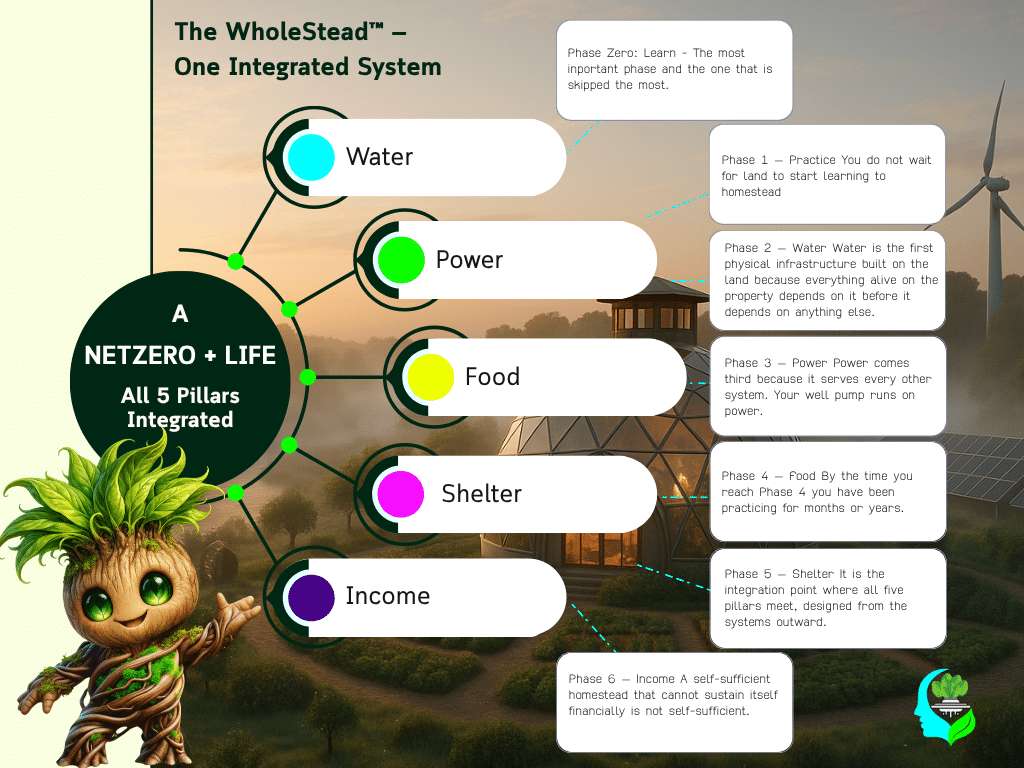
The WholeStead™ Framework is the architecture. It is an eight-phase build sequence that organizes all five pillars of a self-sufficient homestead — Food, Water, Power, Shelter, and Income — into one integrated system where each phase prepares the ground for the next, each pillar strengthens the others, and nothing is built in isolation from everything it depends on.
This article maps the complete framework. Every phase. Every pillar. The reasoning behind every sequence decision. If you have been trying to figure out where to start — or why what you already started does not feel like it is working the way it should — this is the map you have been looking for.
Phase 0 — Learn
The most important phase and the one most people skip. Before you spend a dollar on infrastructure, you study all five pillars simultaneously — not one at a time. Water systems, power generation, food production, shelter design, and income architecture are learned together because they depend on each other, and you cannot plan the integration until you understand the whole. Phase 0 costs you time and attention, not capital. What it saves you is every expensive mistake that comes from building before you understand what you are building.
Phase 1 — Practice
You do not wait for land to start learning to homestead. Whatever space you currently have — a backyard, a balcony, a spare room — becomes your laboratory. You garden in your current soil, keep the smallest animals your setting permits, learn food preservation before you have a harvest large enough to preserve, and track your household’s real water and power consumption so your future systems are sized to actual numbers. Every skill built in Phase 1 is one you carry onto the land already proven. The 18 months it takes to naturalize a garden ecosystem starts the clock now, not on moving day.
Phase 2 — Water
Water is the first physical infrastructure built on the land because everything alive on the property depends on it before it depends on anything else. Your primary source — well, spring, or surface intake — is secured first. Your secondary source, typically rainwater harvest off the roof, backs it up. Storage is sized generously for the family plus livestock plus garden load you will eventually carry. Filtration is designed to your specific water profile, not a generic standard. Nothing on a WholeStead™ uses water once — greywater irrigates trees, roof runoff fills cisterns, and every drop cycles through the system before it leaves the property.
Why water comes before food and power
You can eat preserved food for months while you establish a garden. You can run on generator power while you build your solar array. You cannot go three days without water. Neither can your animals. Neither can seedlings you just transplanted. Water is the one system where the failure mode is immediate and irreversible, which is why it anchors the entire build.
The four components of a WholeStead™ water system
Your primary source — a drilled well, a natural spring, or a surface water intake — is your year-round reliable supply. For most rural properties a well is the gold standard, but at $5,000–$15,000 to drill depending on depth and geology, it is also your largest single water expense. This is exactly why you research the water table on any piece of land before you fall in love with it.
Your secondary source — rainwater harvest off your roof — supplements the primary and covers you during power outages when the electric well pump cannot run. A metal roof is ideal. Every 1,000 square feet collects roughly 620 gallons per inch of rain. In most climates that adds up to a meaningful annual volume.
Your storage — cisterns, tanks, or a combination — bridges the gap between when water arrives and when you need it. For a family plus livestock plus garden, size your storage to carry you through your driest stretch plus two weeks of buffer. Most people undersize this significantly on the first build.
Your filtration and purification — sediment filters, activated carbon, UV sterilization, or reverse osmosis depending on your source water’s specific profile — is what makes all of the above actually drinkable. Always test your water before you design your filtration. What is in it determines what you need to remove.
The WholeStead™ design principle for water
Water that enters the property should leave it having done as much work as possible. Kitchen greywater irrigates fruit trees. Shower water feeds a constructed wetland that filters it back into the soil. Rainwater off the roof waters the garden before the excess goes to the cistern. Nothing is wasted, nothing is single-use, and every drop cycles through the system at least twice before it leaves the property boundary. That closed-loop thinking is what separates a WholeStead™ water system from a conventional one — and it is also what makes the system dramatically more resilient.
Phase 3 — Power
Power comes third because it serves every other system. Your well pump runs on power. Your food preservation runs on power. Your tools, your lights, your communication — all of it. An independent solar array with battery storage sized to your real load removes grid failure as a threat category entirely. The WholeStead™ power target is net zero plus — a system that produces more than it consumes, with surplus available for income-generating activities and community resilience. Every watt you do not need to generate because your shelter is passively designed is a watt you do not need to store, which is why power and shelter are planned together from Phase 0 even though they are built in sequence.
Why power comes third, not first
Solar panels are visible, exciting, and increasingly affordable — they feel like the natural starting point. But a power system sized before you understand your water needs, your food processing load, and your shelter’s thermal design will almost certainly be wrong. You will either undersize it — discovering mid-winter that your battery bank cannot carry you through three cloudy days — or oversize it, spending capital you do not need because you designed it before you knew what you were actually powering. Phase 0 and Phase 1 exist to give you real numbers. Build to those numbers, not to a guess.
The four components of a WholeStead™ power system
Solar panels are your generation source. Size the array to meet your daily load on your worst solar month in your specific location, not your best. Designing for your best sun month leaves you short the rest of the year.
Your battery bank carries you through the night, through cloudy stretches, and through any period when generation does not meet demand. For true resilience the bank should carry you a minimum of three days without any solar input. LiFePO4 chemistry is the current standard: long cycle life, high depth of discharge, thermally stable.
Your charge controller and inverter are the intelligence of the system — the charge controller manages the flow between panels and batteries, the inverter converts stored DC power to the AC your appliances use. Buy quality here. A failed inverter takes the whole system down.
Your backup generator is the bridge for extended periods when solar cannot keep up. Size it, fuel it, and maintain it before you need it. On a well-designed WholeStead™ it runs rarely — but when you need it, you need it completely.
The net zero+ design target
The WholeStead™ power goal is not just independence. It is a system that produces more than it consumes, with surplus available for income-generating activities, community support, and the vehicles and tools the homestead runs on. A passively designed shelter dramatically reduces the power load the solar array needs to cover — every kilowatt-hour you do not need to generate is one you do not need to store, which means smaller panels, smaller batteries, and lower overall cost. The pillars are not independent. They are always talking to each other.
Phase 4 — Food
Food is the pillar most people want to start with, which is exactly why it is positioned fourth. Not because food is less important than water or power, but because a food system built before those foundations are in place is one drought, one power outage, or one supply chain disruption away from failing completely. Build the foundation first. Then build the system that depends on it.
By the time you reach Phase 4 you have been practicing for months or years. You arrive with real skills, real soil knowledge, and real data about what your family actually eats. You are not starting from zero. You are scaling something you have already proven.
The four layers of a WholeStead™ food system
Your annual production layer — vegetables, herbs, annual grains — is your immediate nutrition and most responsive system. It produces within weeks to months and generates the highest variety of fresh food per square foot of any layer. It is also the most labor-intensive and the most vulnerable to seasonal disruption. Essential, and not enough on its own.
Your perennial foundation — fruit and nut trees, berry shrubs, perennial vegetables, a developing food forest — is your long-term caloric security. These systems take three to ten years to reach meaningful production, which is why they are planted as early as possible in Phase 4. A fruit tree planted this year is producing abundantly for your grandchildren. Plant it early. Be patient. It is worth every year of waiting.
Your livestock layer provides protein, fertility, and the biological cycling that makes the whole food system more productive than any of its parts alone. Animal manure feeds the soil that feeds the plants. The plants feed the animals. The waste from food processing feeds the compost that feeds the soil again. Nothing leaves the loop. This closed fertility cycle is what distinguishes a WholeStead™ food system from a garden with chickens next to it.
Your preservation and storage layer converts seasonal abundance into year-round security. Canning, fermenting, dehydrating, root cellaring, freezing with your independent power system — these extend every harvest across the months when nothing is producing. A family that can preserve food eats well in February from what they grew in August. This skill is learned in Phase 1 so it is second nature by Phase 4.
The cash crop dimension
The WholeStead™ food system is designed from the beginning to produce both family nutrition and income — because those two goals, planned together, share soil and labor efficiently. Designed separately, they compete for both. The highest-value crops per square foot — specialty herbs, edible flowers, microgreens, medicinal plants — often require no more space or labor than standard garden crops. The difference between a food garden and a cash-producing garden is frequently just the selection.
Starting over on new land
When you move to new land, you start the naturalization clock over. The soil biology, the beneficial insect population, the pest ecology — none of it transfers from your previous setting. A garden that took 18 months to naturalize where you are now will need a new 18-month cycle on the new property. Your income planning in Phase 0 must account for the food budget your family carries through that transition period. The land will not feed you on day one regardless of how well you plant it. Know this in advance. Build for it.
A note on species selection
Most aquaponics courses will tell you to use tilapia. Do not use tilapia unless it is indigenous to your specific region. Tilapia is one of the most invasive fish species on the planet — a single escape event can establish a feral population in local waterways that displaces native species permanently. For most of North America, native species like bluegill, catfish, or perch are better aquaponics choices and carry none of the invasion risk. The WholeStead™ approach to every species decision starts with the same question: is this animal appropriate for this specific ecosystem?
Phase 5 — Shelter
The WholeStead™ structure is not a house with systems added to it. It is the integration point where all five pillars meet, designed from the systems outward. A conventional contractor builds a conventional house. A WholeStead™ structure is designed around where the water comes in, where the power is stored, how food processing happens, how the roofline serves both rainwater collection and solar generation. Shelter is Phase 5 in the build sequence and Phase 0 in the planning sequence. It must be designed before anything else is sited, because every other system is shaped by it.
The design elements of a WholeStead™ structure
Passive solar orientation reduces heating and cooling loads by 30 to 50 percent compared to a conventionally oriented building — from a correct site plan alone, before a single mechanical system is installed. It is the first decision made and the one all other thermal decisions build on.
Thermal mass — concrete, stone, brick, rammed earth, or adobe — absorbs heat during the day and releases it slowly through the night, moderating temperature swings and reducing mechanical load. A building with good thermal mass feels stable even when outdoor temperatures swing dramatically.
The Norwegian greenhouse method — building a primary structure inside a glass or polycarbonate greenhouse envelope — creates a climate buffer around the entire living space. The greenhouse simply needs to stay above freezing, which dramatically reduces the thermal load on the inner structure. In cold climates it extends the growing season to year-round. It is also extraordinarily beautiful — a home inside a garden, regardless of what is happening outside.
The Russian pechka — a masonry mass heater built around a long, winding combustion path — burns very hot, very clean, and very briefly, then stores that heat in its massive thermal mass for eight to twelve hours. A properly built pechka heats a well-insulated home through a brutal winter on a fraction of the wood a conventional stove would consume. It doubles as a cooking surface and oven. It is the heart of the kitchen.
Geothermal tubing uses the earth’s stable subsurface temperature — typically 50 to 60 degrees Fahrenheit year-round at depth in most of North America — as either a heat source in winter or a heat sink in summer. Combined with a raised floor system, it provides remarkably even, energy-efficient climate control with no combustion and minimal electrical input.
Materials chosen for permanence
Every material decision in a WholeStead™ structure is evaluated on a fifty-year horizon. Stone, rammed earth, concrete, and quality timber outlast vinyl, OSB, and standard dimensional lumber by generations. They cost more upfront and far less over the life of the building. The most expensive shelter mistake in homesteading is building cheaply and paying for it repeatedly. Natural building materials — cob, straw bale, adobe, cordwood — combine thermal mass, breathability, and local sourcing in ways manufactured materials cannot match, and they are largely DIY-accessible.
Designing for multiple generations
A WholeStead™ shelter is not sized for the family that builds it. It is sited and structured for two or three generations. Primary structure designed to expand gracefully, with infrastructure in place to add secondary dwellings as the family grows. Single-floor or ramped access, wide doorways, flexible room configurations — not accommodations added later, but designed in from the beginning. The people who will live in this building for fifty years will not always be the age they are when they build it.
Phase 6 — Income
A self-sufficient homestead that cannot sustain itself financially is not self-sufficient. It is an expensive project with an expiration date. Income is the last pillar built and the first one planned — because every physical decision made from Phase 0 forward should be shaped by how the homestead pays for itself and eventually pays the family.
Every other pillar consumes capital before it produces any return. The entire build is a long series of expenditures against a future return — and if there is no income system generating revenue during that period, you are spending down whatever savings funded the project until they run out. When the savings run out, the homestead stops. Not because the vision was wrong. Because the financial architecture was not built to sustain the timeline.
The four income layers
Layer one is immediate production income — eggs, meat, produce, cut flowers, seedlings, seeds, honey, dairy, value-added preserves and ferments. It starts small and scales with the production systems. The key is designing cash crops alongside food crops from the beginning. The highest-value crops per square foot often require no more space or labor than standard garden crops. The difference is the selection.
Layer two is value-added and skill-based income — dried herbs sell for more than fresh ones, tinctures sell for more than dried herbs, workshops on making tinctures sell for more than the tinctures. The same knowledge, packaged at progressively higher levels of accessibility, generates income that is not dependent on any single harvest and continues through every season including the ones when nothing is growing.
Layer three is digital and documented income — online courses, digital guides, membership communities, and documented knowledge that generates revenue independent of your physical presence or seasonal production. A course built once continues generating income while you sleep, while you harvest, while the food forest you planted five years ago matures. This is exactly what UpRooted Greens is: over 320 courses built on thirty years of formal education and fifteen years of self-directed study, organized in the sequence the framework prescribes. You do not need 320 courses. You need to document what you know and build something that earns independent of whether you showed up in the garden that day.
Layer four is legacy and structural income — land agreements, trusts, agritourism infrastructure, CSA contracts, wholesale relationships, and cooperative structures that generate predictable recurring revenue regardless of market fluctuations. This layer is planned in Phase 0 and built across Phases 4 through 6. It is only available to the homesteads that planned for it from the beginning.
Who this matters most for
The WholeStead™ income architecture was developed by someone who has been building toward a fully integrated homestead on Social Security Disability Income since 2002 — under $900 a month. The income system was not designed from a position of abundance. It was designed from the absolute bottom, because the alternative was a vision that could not survive its own timeline. UpRooted Greens exists for the people the conventional homesteading world does not build for: people on fixed incomes, disability, minimum wage, or no income at all. For those people, income planning is not a nice addition to the homestead plan. It is the load-bearing wall.
The Integration — Why the Whole Is Greater Than the Sum
Each pillar in isolation is useful. Together they are something different entirely.
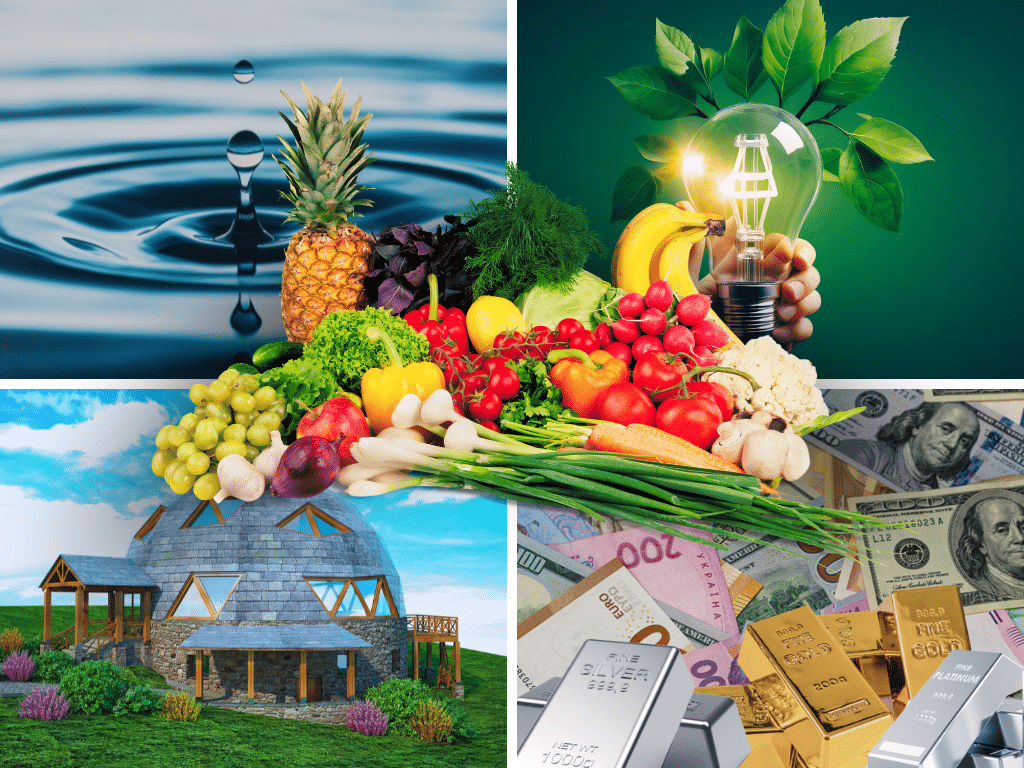
The water system keeps the garden alive and makes the farm stand viable through drought years when competitors’ crops fail. The power system enables food preservation and becomes a teaching destination for people who want to learn how off-grid energy works. The food system feeds the family and funds the market presence. The shelter design reduces the power load and demonstrates at household scale what a city built on the same principles could do at community scale. The income system funds the build and documents the knowledge that outlasts the builder.
Every pillar that serves the family also serves the income architecture when the income architecture is designed to receive it. Every system that works in isolation works harder when it is connected to the others. This is the WholeStead™ — not five projects running in parallel, but one integrated life where every system feeds every other system, nothing is wasted, and the whole compound grows stronger with every season that passes.
The vision does not end at the homestead. A single WholeStead™ that works proves it can be replicated. Replication becomes community. Community becomes the foundation of something larger — a city built from the ground up on the same integrated principles, showing the world that another way is not only possible but already being built, one household at a time.
Your Next Step: Find Your Weakest Link Before It Finds You
You now have the complete map. Eight phases, five pillars, one integrated system. If you have read this far, you already understand something most people in the homesteading space spend years figuring out the hard way: the sequence is not optional, the integration is not a bonus feature, and the income system is not the last thing you think about.
What you need now is an honest picture of where your specific setup stands against that map. Because the most expensive mistake you can make is building confidently in the direction of your strengths while a different system — one you have not fully mapped yet — quietly waits to take everything down. Your water situation is not the same as your neighbor’s. Your power vulnerability is not the same as someone three states over. The gap that will cost you most is yours alone.
The free 10-Point Homestead Vulnerability Assessment inside UpRooted Greens is built to show you exactly that picture. It walks you through all ten critical homestead systems and shows you clearly which ones are solid, which ones have gaps, and where your effort and your dollars will have the greatest impact first. No fluff. No upsell dressed as a resource. Just the honest map of where you actually stand before you commit your next season and your next dollar to a plan that may be missing its most critical layer.
Take the free 10-Point Homestead Vulnerability Assessment
uprootedgreens.com
About the Author
Tihamtu Chaos-Dragon is the founder of UpRooted Greens, a total self-sufficiency education platform built around the WholeStead™ Framework. She has been building toward a fully integrated, net zero+ homestead for ten years on less than $900 a month — developing 320+ courses, running livestock and garden experiments in her subdivision yard, and planning a home that draws on building traditions from Norway, Russia, and beyond. Her final destination is not a homestead. It is a city, built from the ground up, proving that another way is possible. The WholeStead™ is where that proof begins.